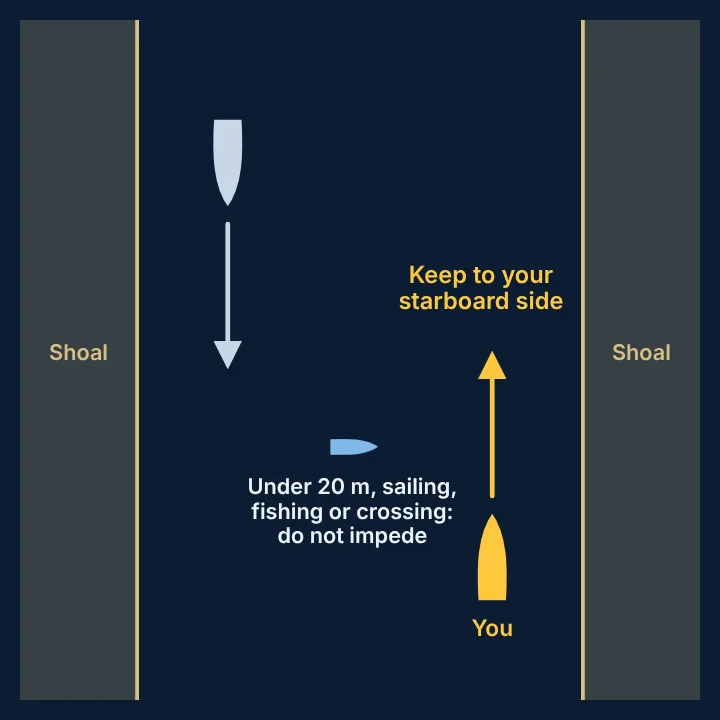
In a narrow channel or fairway you keep as near to the outer limit on your starboard side as is safe and practicable. Small craft, sailing vessels and fishing vessels shall not get in the way of a ship that can only navigate inside the channel. Here is the whole rule, paragraph by paragraph, in plain words.
Each ship keeps as near to the outer limit of the channel on her own starboard side as is safe and practicable, so they meet port to port. Small craft, sailing vessels, vessels fishing and vessels crossing do not impede a ship that can only navigate within the channel.
Quick facts
Keep right
A vessel proceeding along a narrow channel or fairway keeps as near to the outer limit on her starboard side as is safe and practicable (9(a)).
Shall not impede
A vessel of less than 20 m or a sailing vessel shall not impede a vessel that can safely navigate only within the channel (9(b)).
Fishing
A vessel engaged in fishing shall not impede any other vessel navigating within the channel (9(c)).
Crossing
Do not cross if it impedes a vessel that can safely navigate only within the channel. If she doubts your intention she may sound at least five short and rapid blasts (9(d)).
Overtaking
If the vessel ahead must act to let you pass: two prolonged and one short blast for her starboard side, two prolonged and two short for her port side. She answers prolonged, short, prolonged, short, and you still keep clear (9(e), 34(c)).
Bend
Nearing a bend where other vessels may be hidden: one prolonged blast, answered with one prolonged blast by any vessel that hears it (9(f), 34(e)).
Anchoring
Avoid anchoring in a narrow channel if the circumstances admit (9(g)).
"Shall not impede" is not "give way"
Not impeding means acting early, before risk of collision exists, so that the ship in the channel never has to alter or slow down for you (Rule 8(f)). It is a duty that starts sooner than an ordinary give-way duty.
It does not take the steering rules away. If you get so close that risk of collision exists anyway, Rules 13 to 18 apply as well – and the ship in the channel is still required to act if a collision cannot otherwise be avoided.
What is a narrow channel?
The Rules do not give a width. It depends on the place and on the vessels using it: a buoyed fairway into a port is a narrow channel for the ships that need its depth, even if a yacht could sail outside the buoys. Local rules and VTS may say more.
For a small craft the practical answer is simple: if you can keep outside the buoyed channel, do. If you must use it, keep to the starboard edge and cross quickly, at right angles, when nothing big is coming.
Meeting and bends
Keeping to the starboard side makes every meeting a port-to-port passing with no manoeuvre needed. At a bend the ship on the outside of the turn needs more room than you think: her stern swings wide. Sound the prolonged blast before the bend, and listen for the answer.
Common mistakes
A yacht under sail holding her course across the bow of a ship in the fairway because "power gives way to sail". In a narrow channel she shall not impede the ship.
Reading "shall not impede" as "the ship has right of way whatever happens". When risk of collision exists the steering rules apply to both.
Navigating in the middle of the channel. The rule says the outer limit on your starboard side, as near as is safe.
Overtaking in a channel on the agreement signal and then relaxing. Agreement does not move the duty: the overtaking vessel still keeps clear (Rule 13).
Anchoring in the fairway to fish or wait for the tide.
Written by a serving chief officer and master mariner. Summaries in our own words – the official text is the COLREGs (IMO, 1972, as amended).
Test yourself
Question 1 of 7
In a narrow channel, a vessel of less than 20 m or a sailing vessel shall:
Correct!Not quite. The answer is Not impede the passage of a vessel which can safely navigate only within the channel.
Rule 9(b): a vessel of less than 20 metres in length or a sailing vessel shall not impede the passage of a vessel which can safely navigate only within a narrow channel or fairway. (Rule 9(b))
Question 2 of 7
In a narrow channel, a vessel proceeding along the course of the channel shall keep:
Correct!Not quite. The answer is As near to the outer limit of the channel on her starboard side as is safe and practicable.
Rule 9(a): a vessel proceeding along the course of a narrow channel or fairway shall keep as near to the outer limit of the channel or fairway which lies on her starboard side as is safe and practicable. (Rule 9(a))
Question 3 of 7
In a narrow channel, a vessel engaged in fishing:
Correct!Not quite. The answer is Shall not impede the passage of any other vessel navigating within the channel.
Rule 9(c): a vessel engaged in fishing shall not impede the passage of any other vessel navigating within a narrow channel or fairway. (Rule 9(c))
Question 4 of 7
May you cross a narrow channel?
Correct!Not quite. The answer is Yes, but not if it impedes a vessel which can safely navigate only within the channel.
Rule 9(d): a vessel shall not cross a narrow channel or fairway if such crossing impedes the passage of a vessel which can safely navigate only within such channel or fairway. That vessel may sound five short blasts if in doubt about your intentions. (Rule 9(d))
Question 5 of 7
In a narrow channel you can only overtake if the vessel ahead takes action to let you pass. What do you do?
Correct!Not quite. The answer is Indicate your intention with the sound signal in Rule 34(c)(i) and wait for her agreement.
Rule 9(e)(i): the vessel intending to overtake shall indicate her intention by sounding the signal in Rule 34(c)(i). The vessel to be overtaken shall, if in agreement, sound the signal in Rule 34(c)(ii) and take steps to permit safe passing. If in doubt she may sound the signal in Rule 34(d). (Rule 9(e)(i))
Question 6 of 7
You are nearing a bend in a channel where other vessels may be hidden by an obstruction. What shall you do?
Correct!Not quite. The answer is Navigate with particular alertness and caution and sound one prolonged blast.
Rule 9(f) and Rule 34(e): approach with particular alertness and caution and sound one prolonged blast. Any vessel round the bend that hears it answers with one prolonged blast. (Rule 9(f), 34(e))
Question 7 of 7
What does Rule 9 say about anchoring in a narrow channel?
Correct!Not quite. The answer is Any vessel shall, if the circumstances admit, avoid anchoring in a narrow channel.
Rule 9(g): any vessel shall, if the circumstances of the case admit, avoid anchoring in a narrow channel. (Rule 9(g))
You have right out of answered.The app draws every question new: other angles, other light, other wrong answers.
Learn it until you see it in your sleep
Lanterna draws every vessel from the rules, from every angle, in changing light and weather, and asks until you know her. Lights and shapes, COLREGs with "what do you do?" situations, buoyage, sound signals, flags, VHF and Morse. Works offline.
Free round of ten questions in every category, then everything with a single purchase. Lanterna is independent and not affiliated with the IMO or any maritime authority.