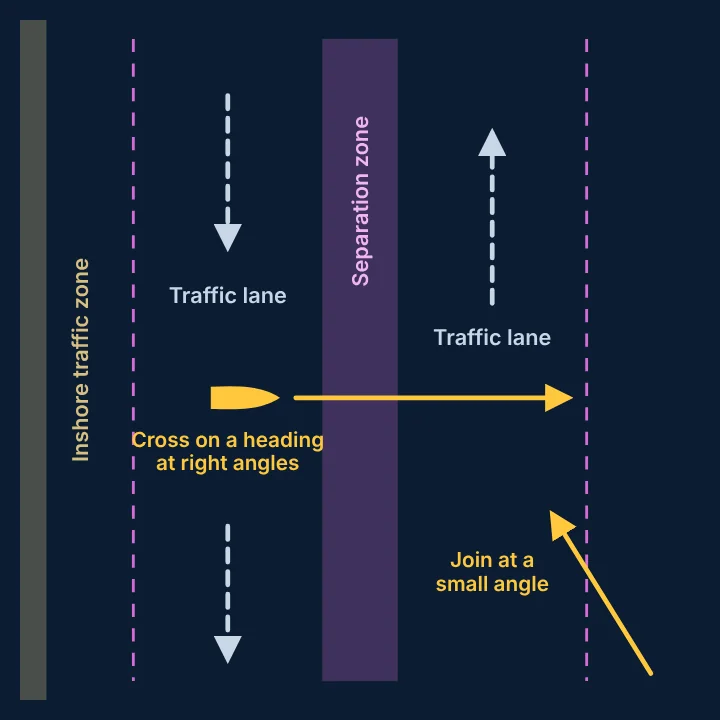
A traffic separation scheme sorts ships into lanes, but it gives nobody right of way. Here is how to follow a lane, how to join, leave and cross one, who may use the inshore traffic zone, and which vessels shall not impede traffic in the lane.
A traffic separation scheme: follow the lane in the direction of the arrows, join or leave it at a small angle, and if you must cross, cross on a heading at right angles to the traffic. The inshore traffic zone lies between the scheme and the coast.
Quick facts
Applies to
Schemes adopted by the IMO. It does not relieve any vessel of her obligations under any other rule (10(a)).
In the lane
Proceed in the general direction of traffic for that lane, and keep clear of the separation line or zone as far as practicable (10(b)).
Joining, leaving
Normally at the end of the lane. From the side: at as small an angle to the direction of traffic as practicable.
Crossing
Avoid it as far as practicable. If you must: on a heading as nearly as practicable at right angles to the direction of traffic (10(c)).
Inshore zone
Not for through traffic that can safely use the lane. Vessels of less than 20 m, sailing vessels and vessels fishing may use it; so may anyone bound to or from a place inside it, or avoiding immediate danger (10(d)).
Shall not impede
A vessel fishing: any vessel following a lane (10(i)). A vessel of less than 20 m or a sailing vessel: a power-driven vessel following a lane (10(j)).
Also
Stay out of the separation zone, take particular care near the ends of the scheme, avoid anchoring in it, and if you do not use it keep well away from it (10(e)–(h)).
A lane is not a right of way
Two power-driven vessels in sight of one another, one following the lane and one crossing it: Rule 15 decides who gives way, exactly as in open sea. The ship in the lane may well be the give-way vessel. Rule 10 only adds that small craft, sailing vessels and vessels fishing shall not impede her.
Heading, not track
The rule says heading at right angles. In a cross tide your track over the ground will then be diagonal, and that is intended: it gets you across in the shortest time and shows the ships in the lane a clear beam-on aspect and a clear radar picture. Do not steer up-tide to make your track square.
The separation zone
A vessel does not normally enter a separation zone or cross a separation line except to cross the scheme, to join or leave a lane, in an emergency to avoid immediate danger, or to fish inside the zone (10(e)).
A vessel restricted in her ability to manoeuvre while keeping up safety of navigation in the scheme, or laying, servicing or picking up a submarine cable there, is exempt from the rule as far as her work requires (10(k) and (l)).
Common mistakes
Believing that following the lane makes you the stand-on vessel. Rules 13 to 18 apply inside a scheme as everywhere else.
Crossing with the track at right angles by heading up into the tide. The rule is about heading.
Using the inshore traffic zone as a short cut on a through passage in a ship that could safely use the lane.
Joining a lane from the side at a broad angle, looking like a crossing vessel to everyone in it.
Fishing or sailing in a lane and holding on. Both shall not impede traffic following the lane.
Written by a serving chief officer and master mariner. Summaries in our own words – the official text is the COLREGs (IMO, 1972, as amended).
Test yourself
Question 1 of 8
If you have to cross a traffic lane, you shall as far as practicable cross:
Correct!Not quite. The answer is On a heading as nearly as practicable at right angles to the general direction of traffic flow.
Rule 10(c): a vessel shall, so far as practicable, avoid crossing traffic lanes but if obliged to do so shall cross on a heading as nearly as practicable at right angles to the general direction of traffic flow. (Rule 10(c))
Question 2 of 8
Does Rule 10 (traffic separation schemes) relieve a vessel of her obligations under the other Rules?
Correct!Not quite. The answer is No – Rule 10 does not relieve any vessel of her obligation under any other rule.
Rule 10(a): this Rule applies to traffic separation schemes adopted by the Organization and does not relieve any vessel of her obligation under any other rule. (Rule 10(a))
Question 3 of 8
A vessel using a traffic separation scheme shall:
Correct!Not quite. The answer is Proceed in the appropriate traffic lane in the general direction of traffic flow for that lane.
Rule 10(b)(i): proceed in the appropriate traffic lane in the general direction of traffic flow for that lane. As far as practicable keep clear of the separation line or zone, and normally join or leave at the termination of a lane – from the side at as small an angle as practicable. (Rule 10(b))
Question 4 of 8
When joining or leaving a traffic lane from the side, you shall do so:
Correct!Not quite. The answer is At as small an angle to the general direction of traffic flow as practicable.
Rule 10(b)(iii): normally join or leave a traffic lane at the termination of the lane, but when joining or leaving from either side do so at as small an angle to the general direction of traffic flow as practicable. (Rule 10(b)(iii))
Question 5 of 8
Which vessels may use an inshore traffic zone even though they could safely use the traffic lane?
Correct!Not quite. The answer is Vessels under 20 m, sailing vessels and vessels engaged in fishing.
Rule 10(d)(i): a vessel shall not use an inshore traffic zone when she can safely use the appropriate traffic lane. However, vessels of less than 20 m, sailing vessels and vessels engaged in fishing may use it. (10(d)(ii) also allows vessels going to or from a port, installation or pilot station inside the zone.) (Rule 10(d))
Question 6 of 8
A vessel NOT using a traffic separation scheme shall:
Correct!Not quite. The answer is Avoid it by as wide a margin as is practicable.
Rule 10(h): a vessel not using a traffic separation scheme shall avoid it by as wide a margin as is practicable. (Rule 10(h))
Question 7 of 8
In a traffic lane, a vessel engaged in fishing:
Correct!Not quite. The answer is Shall not impede the passage of any vessel following the traffic lane.
Rule 10(i): a vessel engaged in fishing shall not impede the passage of any vessel following a traffic lane. Rule 10(j): a vessel under 20 m or a sailing vessel shall not impede the safe passage of a power-driven vessel following a traffic lane. (Rule 10(i))
Question 8 of 8
In a traffic separation scheme, a vessel of less than 20 m or a sailing vessel:
Correct!Not quite. The answer is Shall not impede the safe passage of a power-driven vessel following a traffic lane.
Rule 10(j): a vessel of less than 20 metres in length or a sailing vessel shall not impede the safe passage of a power-driven vessel following a traffic lane. (Rule 10(j))
You have right out of answered.The app draws every question new: other angles, other light, other wrong answers.
Learn it until you see it in your sleep
Lanterna draws every vessel from the rules, from every angle, in changing light and weather, and asks until you know her. Lights and shapes, COLREGs with "what do you do?" situations, buoyage, sound signals, flags, VHF and Morse. Works offline.
Free round of ten questions in every category, then everything with a single purchase. Lanterna is independent and not affiliated with the IMO or any maritime authority.