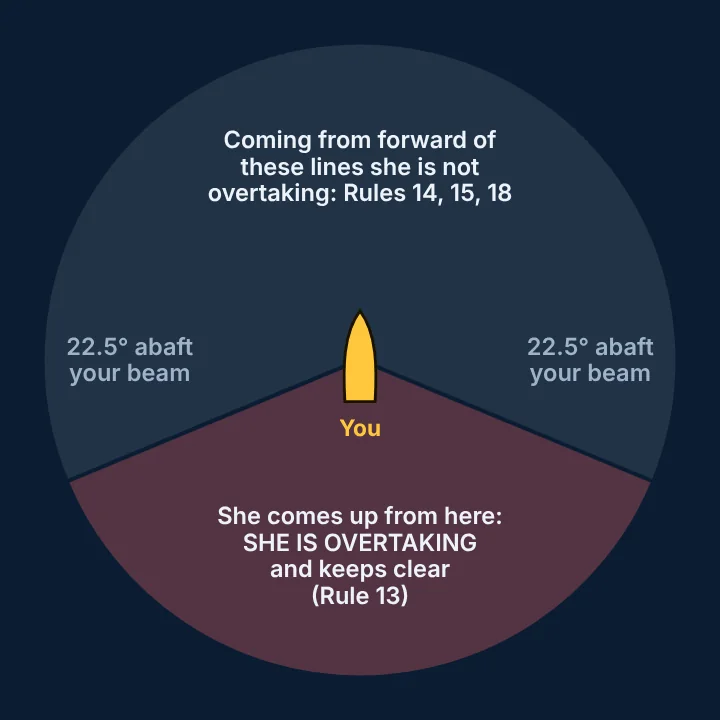
Any vessel overtaking any other keeps out of the way of the vessel being overtaken. No other rule in the steering and sailing rules is this blunt: it comes before crossing, before power and sail, before fishing. Here is how to tell that you are overtaking, and how long it lasts.
Seen from the vessel being overtaken. The red sector is the arc of your sternlight: a vessel coming up inside it, more than 22.5° abaft your beam, is overtaking you and keeps clear until she is finally past and clear.
Quick facts
Applies to
Any vessel overtaking any other, in sight of one another – whatever Rules 4 to 18 otherwise say.
Overtaking is
Coming up with another vessel from a direction more than 22.5° abaft her beam – where, at night, you would see only her sternlight and neither of her sidelights.
In doubt
If you are in any doubt whether you are overtaking, assume that you are and act accordingly (Rule 13(c)).
How long
Until you are finally past and clear. No later change of bearing makes you a crossing vessel or relieves you of the duty (Rule 13(d)).
The vessel ahead
She is the stand-on vessel: she keeps her course and speed (Rule 17).
In a narrow channel
If she must move over to let you pass: two prolonged and one short blast = "I intend to overtake on your starboard side" (two short for port). She agrees with prolonged, short, prolonged, short (Rule 34(c)).
Rule 13 comes first
Rule 18 begins "except where Rules 9, 10 and 13 otherwise require". So a sailing vessel overtaking a power-driven vessel keeps clear of her. So does a fishing vessel, and so does a ship that would have been the stand-on vessel if the two had been crossing.
It is the sector you come from that decides, not your speed or your type.
Overtaking or crossing?
The line is 22.5° abaft the beam – the edge of her sternlight and of her sidelight. Close to that line, by day or with her lights swinging in a seaway, you often cannot be sure. That is what Rule 13(c) is for: assume you are overtaking and keep clear.
Once you are overtaking you stay overtaking. Coming up on her starboard quarter and drawing ahead until you have her on your port bow does not turn her into the give-way vessel of a crossing.
Passing safely
Give her room: a large ship passing close pulls a smaller one in towards her, most of all in shallow water. Pass at a distance that still works if she alters a little or you lose steering, and do not cut in ahead of her before you are well clear.
In restricted visibility Rule 13 does not apply – it is for vessels in sight of one another. On radar alone, Rule 19 applies to both of you.
Common mistakes
A sailing vessel overtaking a ship and expecting her to give way. The overtaking vessel keeps clear, also under sail.
Deciding it is a crossing because the other vessel is slower and "should" keep clear. If you came up from more than 22.5° abaft her beam, you are overtaking.
Thinking the duty ends when you are abeam of her. It ends when you are finally past and clear.
The vessel being overtaken altering course or slowing down across the other. She is the stand-on vessel: course and speed.
Using the overtaking signals of Rule 34(c) in open water. They are for a narrow channel or fairway, when she has to act to let you pass.
Written by a serving chief officer and master mariner. Summaries in our own words – the official text is the COLREGs (IMO, 1972, as amended).
Test yourself
Question 1 of 8
You are on a power-driven vessel making way. At night you see these lights right ahead (355° relative). The compass bearing is steady and the range is closing. What do you do?
Relative bearing 355°
Correct!Not quite. The answer is Keep out of her way – you are overtaking her.
She is: pilot vessel on duty. Rule 13: you see her sternlight (and a towing vessel's yellow towing light above it) but none of her masthead lights or sidelights, so you are coming up from more than 22.5° abaft her beam. You are overtaking and must keep out of her way until you are finally past and clear.
Relative bearing 355°
By day
Question 2 of 8
You are on a power-driven vessel making way. At night you see these lights on your port quarter (202° relative). The compass bearing is steady and the range is closing. What do you do?
Relative bearing 202°
Correct!Not quite. The answer is Stand on – she is overtaking you: keep your course and speed.
She is: power-driven vessel towing, tow 200 m or less, towing astern. Rule 13: a vessel coming up from more than 22.5° abaft your beam is overtaking and must keep out of your way. Rule 17: you keep your course and speed.
Relative bearing 202°
By day
Question 3 of 8
A sailing vessel is overtaking a power-driven vessel. Who keeps out of the way?
Correct!Not quite. The answer is The sailing vessel – she is overtaking.
Rule 13(a): notwithstanding anything in Rules 4–18, any vessel overtaking any other shall keep out of the way of the vessel being overtaken. Rule 18 does not change that. (Rule 13(a))
Question 4 of 8
When is a vessel deemed to be overtaking?
Correct!Not quite. The answer is When coming up with another vessel from a direction more than 22.5° abaft her beam.
Rule 13(b): a vessel shall be deemed to be overtaking when coming up with another vessel from a direction more than 22.5 degrees abaft her beam – at night she would see only the sternlight. (Rule 13(b))
Question 5 of 8
You are in doubt whether you are overtaking another vessel. What shall you assume?
Correct!Not quite. The answer is That you are overtaking, and act accordingly.
Rule 13(c): when a vessel is in any doubt as to whether she is overtaking another, she shall assume that this is the case and act accordingly. (Rule 13(c))
Question 6 of 8
You are overtaking another vessel. When does your duty to keep out of her way end?
Correct!Not quite. The answer is When you are finally past and clear.
Rule 13(d): any subsequent alteration of the bearing does not make the overtaking vessel a crossing vessel or relieve her of the duty of keeping clear until she is finally past and clear. (Rule 13(d))
Question 7 of 8
In a narrow channel you can only overtake if the vessel ahead takes action to let you pass. What do you do?
Correct!Not quite. The answer is Indicate your intention with the sound signal in Rule 34(c)(i) and wait for her agreement.
Rule 9(e)(i): the vessel intending to overtake shall indicate her intention by sounding the signal in Rule 34(c)(i). The vessel to be overtaken shall, if in agreement, sound the signal in Rule 34(c)(ii) and take steps to permit safe passing. If in doubt she may sound the signal in Rule 34(d). (Rule 9(e)(i))
Question 8 of 8
The vessel ahead in a narrow channel has agreed to let you overtake. Who is responsible for keeping clear?
Correct!Not quite. The answer is You are – Rule 9(e) does not relieve the overtaking vessel of her obligation under Rule 13.
Rule 9(e)(ii): this Rule does not relieve the overtaking vessel of her obligation under Rule 13. (Rule 9(e)(ii))
You have right out of answered.The app draws every question new: other angles, other light, other wrong answers.
Learn it until you see it in your sleep
Lanterna draws every vessel from the rules, from every angle, in changing light and weather, and asks until you know her. Lights and shapes, COLREGs with "what do you do?" situations, buoyage, sound signals, flags, VHF and Morse. Works offline.
Free round of ten questions in every category, then everything with a single purchase. Lanterna is independent and not affiliated with the IMO or any maritime authority.