Vessel constrained by her draught: lights and day shape
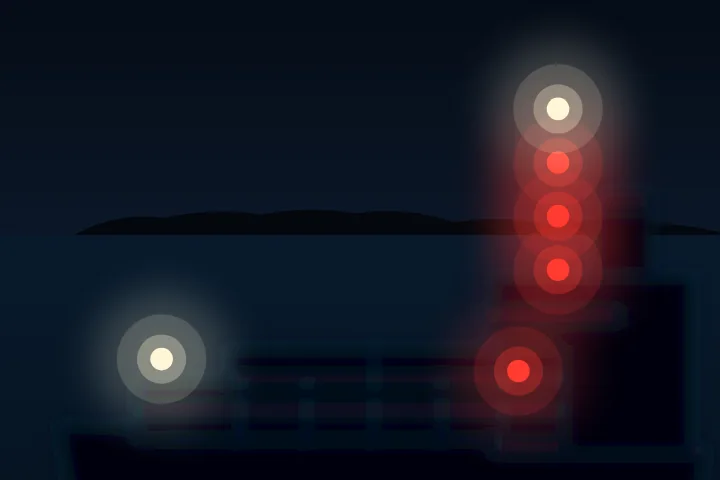
Three reds in a vertical line on top of the lights of a power-driven vessel: a deep ship that cannot leave the deep water. Here is what she shows, and what she can – and cannot – expect from you. COLREG Rule 28 and Rule 18(d).
Seen from aheadFrom her starboard sideFrom asternFrom her port bowBy day: a cylinder
Quick facts
At night
The lights of a power-driven vessel (masthead lights, sidelights, sternlight), and she may show three all-round red lights in a vertical line.
By day
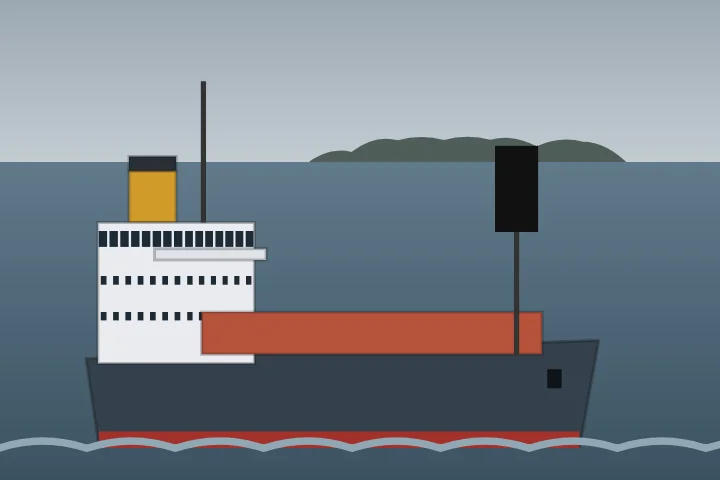
She may show a cylinder.
Only
A power-driven vessel can be constrained by her draught – never a sailing vessel.
In fog
One prolonged followed by two short blasts, at intervals of not more than 2 minutes (Rule 35(c)).
Who keeps clear
Every vessel except NUC and RAM shall, if the circumstances admit, avoid impeding her safe passage. She shall navigate with particular caution (Rule 18(d)).
A status, not a type of ship
Rule 3(h): a power-driven vessel that, because of her draught compared with the depth and width of the water, is severely restricted in her ability to deviate from her course. The same tanker is CBD in a narrow dredged channel and an ordinary power-driven vessel in open sea.
The US Inland Rules have no Rule 28 – inland in the United States the signal is not used.
"Avoid impeding" is not "keep out of the way"
Avoiding impeding means acting early, before risk of collision has developed, so that she never has to change her plan. If you get so close that there is risk of collision anyway, the normal steering and sailing rules apply to both of you (Rule 8(f)).
Common mistakes
Thinking she has right of way over everyone. NUC and RAM vessels do not have to avoid impeding her, and once risk of collision exists the normal rules apply.
Mixing up three reds with a vessel aground. Aground: two reds and the white anchor lights, no sidelights. CBD: three reds over the lights of a ship underway.
Expecting the signal on every deep ship. It is optional – "may" – and many deep-draught ships never show it.
Forgetting that sailing and fishing vessels must avoid impeding her too.
Written by a serving chief officer and master mariner. Summaries in our own words – the official text is the COLREGs (IMO, 1972, as amended).
Test yourself
Question 1 of 6
At night you see these lights. What is it?
Correct!Not quite. The answer is Vessel constrained by her draught.
The lights of a power-driven vessel, and she may also show three all-round red lights in a vertical line. By day she may show a cylinder. You are on her starboard bow. Rule 28
By day
Question 2 of 6
By day: which picture shows a vessel constrained by her draught?
Correct!Not quite. The answer is Vessel constrained by her draught.
The lights of a power-driven vessel, and she may also show three all-round red lights in a vertical line. By day she may show a cylinder. In the right picture you are on her starboard bow. Rule 28
Question 3 of 6
This is a vessel constrained by her draught. By day she shows these shapes. What is wrong?
Correct!Not quite. The answer is She should show: cylinder (top to bottom).
She shows ball (top to bottom) but should show cylinder (top to bottom). The lights of a power-driven vessel, and she may also show three all-round red lights in a vertical line. By day she may show a cylinder. Rule 28
Question 4 of 6
A vessel constrained by her draught is:
Correct!Not quite. The answer is A power-driven vessel severely restricted in her ability to deviate from her course because of her draught in relation to the available depth and width of water.
Rule 3(h): a power-driven vessel which, because of her draught in relation to the available depth and width of navigable water, is severely restricted in her ability to deviate from the course she is following. (Rule 3(h))
Question 5 of 6
Which vessels shall, if the circumstances admit, avoid impeding the safe passage of a vessel constrained by her draught?
Correct!Not quite. The answer is Any vessel other than one not under command or restricted in her ability to manoeuvre.
Rule 18(d)(i): any vessel other than a vessel not under command or a vessel restricted in her ability to manoeuvre shall, if the circumstances of the case admit, avoid impeding the safe passage of a vessel constrained by her draught, exhibiting the signals in Rule 28. (Rule 18(d))
Question 6 of 6
How shall a vessel constrained by her draught navigate?
Correct!Not quite. The answer is With particular caution, having full regard to her special condition.
Rule 18(d)(ii): a vessel constrained by her draught shall navigate with particular caution having full regard to her special condition. (Rule 18(d)(ii))
You have right out of answered.The app draws every question new: other angles, other light, other wrong answers.
Learn it until you see it in your sleep
Lanterna draws every vessel from the rules, from every angle, in changing light and weather, and asks until you know her. Lights and shapes, COLREGs with "what do you do?" situations, buoyage, sound signals, flags, VHF and Morse. Works offline.
Free round of ten questions in every category, then everything with a single purchase. Lanterna is independent and not affiliated with the IMO or any maritime authority.