Lanterna

Rule 14: the head-on situation

Two power-driven vessels meeting on reciprocal or nearly reciprocal courses, with risk of collision: each alters course to starboard and they pass port to port. There is no stand-on vessel. Here is how to recognise it, and what to do when you are not sure.

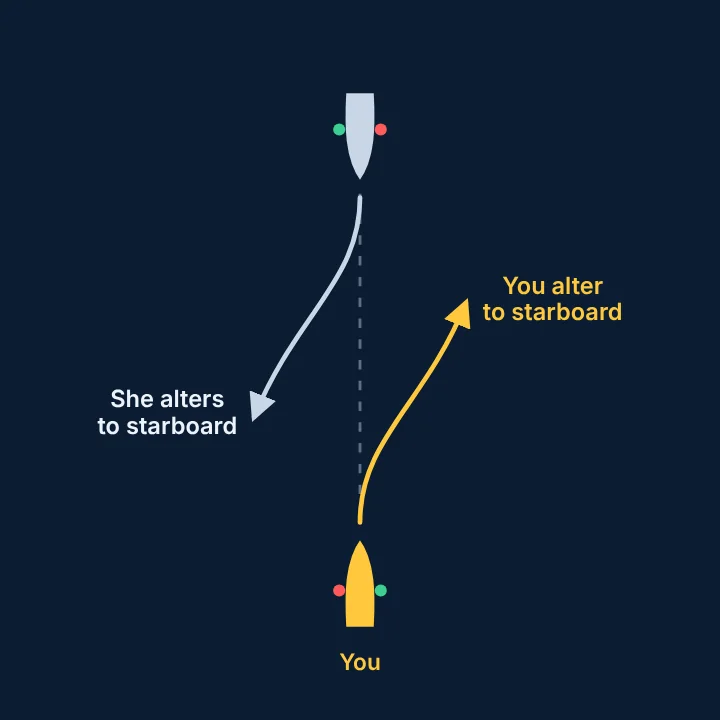
Diagram of two vessels meeting head-on, each altering course to starboard to pass port to port.
Two power-driven vessels meeting head-on: each alters her course to starboard and they pass port to port, red to red. Neither is the stand-on vessel.

Quick facts

Applies to
Two power-driven vessels in sight of one another, meeting on reciprocal or nearly reciprocal courses so as to involve risk of collision.
Action
Each alters her course to starboard, so that each passes on the port side of the other.
At night
You see her ahead or nearly ahead with her masthead lights in line or nearly in line, and/or both sidelights.
By day
You see her ahead or nearly ahead in the corresponding aspect: bow on, masts in line.
In doubt
If you are in any doubt whether it is a head-on situation, assume that it is and act accordingly (Rule 14(c)).
Sound signal
One short blast as you alter: "I am altering my course to starboard" (Rule 34(a)).

Nobody stands on

In a crossing one vessel gives way and the other keeps her course and speed. Head-on, both have the same duty. Do not wait to see what she does: alter to starboard early and enough for her to see your red sidelight open and your masts move apart.

Head-on, or a fine crossing?

A vessel a few degrees on your bow, showing mostly one sidelight, may be head-on or a crossing at a fine angle. The answer is the same in both the cases that matter: if it is head-on you alter to starboard, and if she is fine on your starboard bow you are the give-way vessel and alter to starboard anyway.

The trap is the vessel fine on your port bow, green to green, with little room. Altering to port to "open the distance" is how the classic head-on collisions happen – she may alter to starboard as Rule 14 tells her to. If there is doubt, it is head-on: starboard.

When Rule 14 does not apply

It is between two power-driven vessels. Two sailing vessels meeting follow Rule 12, and a power-driven vessel meeting a sailing vessel, a vessel fishing, not under command or restricted in her ability to manoeuvre keeps out of her way under Rule 18.

In restricted visibility, with the other vessel on radar only, Rule 19 applies – and it gives the same hint: for a target forward of the beam, avoid altering to port.

Common mistakes

  1. Altering to port to widen a green-to-green passing. If she follows the rule and goes to starboard, you meet in the middle.
  2. Waiting for the other vessel to act first. Both shall alter to starboard.
  3. A string of small alterations. Make one that she can see: she loses your green sidelight and is left with the red.
  4. Calling it head-on between a ship and a sailing vessel. Then Rule 18 decides: the power-driven vessel keeps out of the way.
  5. Forgetting the whistle. One short blast tells her what you are doing while she can still act on it.

Test yourself

Question 1 of 7

You are on a power-driven vessel making way. At night you see these lights right ahead (000° relative). The compass bearing is steady and the range is closing. What do you do?

AHEADRelative bearing 000°
Answers

Correct!Not quite. The answer is Alter course to starboard – you are meeting head-on.

She is: pilot vessel on duty. Rule 14: two power-driven vessels meeting on reciprocal or nearly reciprocal courses. Each alters course to starboard so that they pass port to port. If in doubt, assume it is head-on.
AHEADRelative bearing 000°
By day

Question 2 of 7

In a head-on situation between two power-driven vessels:

Answers

Correct!Not quite. The answer is Each alters course to starboard so that they pass port to port.

Rule 14(a): when two power-driven vessels are meeting on reciprocal or nearly reciprocal courses so as to involve risk of collision, each shall alter her course to starboard so that each shall pass on the port side of the other. (Rule 14(a))

Question 3 of 7

At night, how do you know you are in a head-on situation?

Answers

Correct!Not quite. The answer is You see the other vessel’s masthead lights in a line or nearly in a line and/or both sidelights.

Rule 14(b): such a situation shall be deemed to exist when a vessel sees the other ahead or nearly ahead and by night she could see the masthead lights of the other in a line or nearly in a line and/or both sidelights, and by day the corresponding aspect. (Rule 14(b))

Question 4 of 7

You are in doubt whether a head-on situation exists. What shall you do?

Answers

Correct!Not quite. The answer is Assume that it does exist and act accordingly.

Rule 14(c): when a vessel is in any doubt as to whether such a situation exists she shall assume that it does exist and act accordingly. (Rule 14(c))

Question 5 of 7

By day, how do you know you are in a head-on situation?

Answers

Correct!Not quite. The answer is You see the other vessel ahead or nearly ahead with her masts in line or nearly in line.

Rule 14(b): such a situation shall be deemed to exist when a vessel sees the other ahead or nearly ahead, and by night she could see the masthead lights in a line or nearly in a line and/or both sidelights, and by day she observes the corresponding aspect of the other vessel. (Rule 14(b))

Question 6 of 7

Restricted visibility (about 0.3 nm). You are a power-driven vessel making way and sounding your fog signal. Radar shows an echo right ahead (358° relative), 2.8 nm, bearing steady and range closing. Your plot shows you are not overtaking her. Nothing is in sight. What do you do?

42HEAD UP6 NM
Answers

Correct!Not quite. The answer is Alter course to starboard in ample time.

Rule 19(d)(i): avoid an alteration of course to port for a vessel forward of the beam (other than one being overtaken). In restricted visibility there is no stand-on or give-way vessel – both must take avoiding action in ample time, and the manoeuvring signals of Rule 34(a) are only for vessels in sight of one another. Reducing speed is always an option too.

Question 7 of 7

When does a power-driven vessel give the manoeuvring signals of Rule 34(a) (for example one short blast)?

Answers

Correct!Not quite. The answer is When vessels are in sight of one another and she is manoeuvring as authorised or required by the Rules.

Rule 34(a): when vessels are in sight of one another, a power-driven vessel underway, when manoeuvring as authorised or required by these Rules, shall indicate that manoeuvre by signals on her whistle. (Rule 34(a))

You have right out of answered.The app draws every question new: other angles, other light, other wrong answers.

Learn it until you see it in your sleep

Lanterna draws every vessel from the rules, from every angle, in changing light and weather, and asks until you know her. Lights and shapes, COLREGs with "what do you do?" situations, buoyage, sound signals, flags, VHF and Morse. Works offline.

Free round of ten questions in every category, then everything with a single purchase. Lanterna is independent and not affiliated with the IMO or any maritime authority.

Read next