Quick facts
- Applies to
- Two power-driven vessels in sight of one another, crossing so as to involve risk of collision.
- Give way
- The vessel that has the other on her own starboard side. If the circumstances admit, she avoids crossing ahead of the other.
- Give-way vessel
- Early and substantial action, to keep well clear (Rule 16).
- Stand-on vessel
- Keeps her course and speed. She may act when it becomes apparent that the other is not acting, and shall act when collision cannot be avoided by the give-way vessel alone (Rule 17).
- If the stand-on acts
- Not alter course to port for a vessel on her own port side, if the circumstances admit (Rule 17(c)).
- Sound signals
- In sight: one short blast = "I am altering my course to starboard". Five or more short and rapid blasts = doubt (Rule 34).
Crossing, head-on or overtaking?
If the compass bearing of an approaching vessel does not change appreciably, risk of collision exists (Rule 7(d)). Then decide which rule applies:
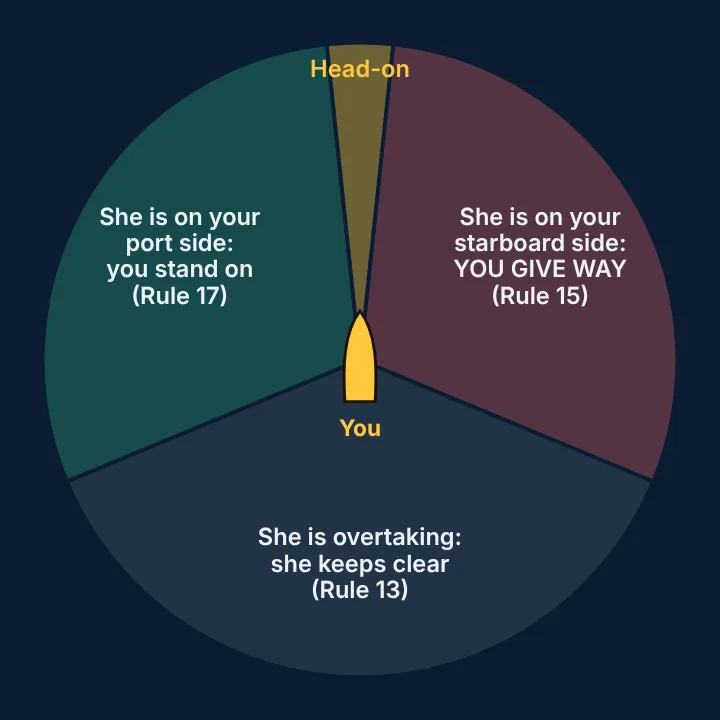
Head-on (Rule 14): she is ahead or nearly ahead, on a reciprocal course – her masthead lights in line and both sidelights visible. Both alter to starboard.
Overtaking (Rule 13): she comes up from more than 22.5° abaft your beam, where she can see only your sternlight. The overtaking vessel keeps clear, whatever her type.
Crossing (Rule 15): everything in between. At night: if you see her red sidelight she is on your starboard side and you give way. In doubt about overtaking, assume you are overtaking (13(c)); in doubt about head-on, assume head-on (14(c)).
What the give-way vessel does
A bold alteration to starboard, made early, so that she sees your port side and you pass astern of her – or reduce speed or stop. The alteration must be large enough to be readily apparent on her radar and from her bridge (Rule 8(b)), and you check that it works until she is past and clear (Rule 8(d)).
When Rule 15 does not decide
Rule 18 comes first between different kinds of vessels: a power-driven vessel keeps out of the way of a sailing vessel or a vessel engaged in fishing whichever side she is on. In a narrow channel or a traffic separation scheme, Rules 9 and 10 come in as well. And when the vessels cannot see each other, Rule 19 applies instead – there is no stand-on vessel in fog.
Learn it until you see it in your sleep
Lanterna draws every vessel from the rules, from every angle, in changing light and weather, and asks until you know her. Lights and shapes, COLREGs with "what do you do?" situations, buoyage, sound signals, flags, VHF and Morse. Works offline.
Free round of ten questions in every category, then everything with a single purchase. Lanterna is independent and not affiliated with the IMO or any maritime authority.