In fog there is no stand-on vessel. Every vessel that detects another by radar alone must decide if risk of collision exists, and act in ample time – without turning the wrong way. Here is Rule 19 in plain words, with the turns to avoid.
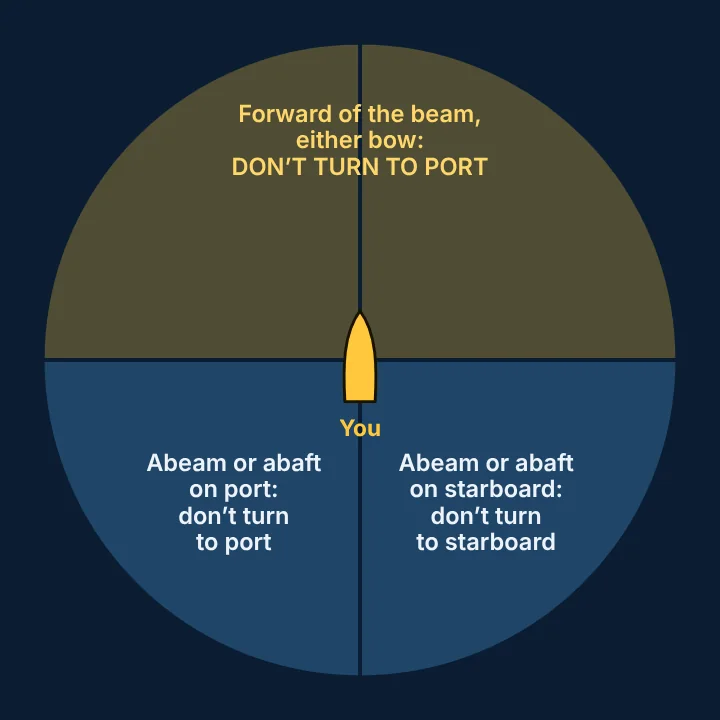
Radar target, not in sight, risk of collision: the alterations of course Rule 19(d) tells you to avoid. Forward of the beam the exception is a vessel you are overtaking.
Quick facts
Applies to
Vessels not in sight of one another, in or near an area of restricted visibility (fog, heavy rain, snow).
Speed
A safe speed for the visibility. A power-driven vessel has her engines ready for immediate manoeuvre.
Radar alone
Decide if a close-quarters situation is developing or risk of collision exists. If so, act in ample time.
Avoid
An alteration to port for a vessel forward of the beam (unless you are overtaking her), and an alteration towards a vessel abeam or abaft the beam.
Fog signal ahead
Hear a fog signal apparently forward of the beam? Reduce to the minimum speed at which you can keep your course, take all way off if necessary, and navigate with extreme caution.
Your own signal
A power-driven vessel making way: one prolonged blast at intervals of not more than 2 minutes (Rule 35(a)).
No stand-on, no give-way
Rules 11 to 18 – overtaking, head-on, crossing, stand-on – apply only to vessels in sight of one another. In fog, Rule 19 gives every vessel the same duty: assess the situation and act in ample time. The moment the other vessel comes into sight, the rules for vessels in sight apply again – assess the situation again straight away.
Which way to turn for a radar target
Forward of the beam, either bow: avoid turning to port. A bold turn to starboard, or a reduction of speed, is the usual answer. The exception is a vessel you are overtaking.
Abeam or abaft the beam: avoid turning towards her. A vessel closing on your starboard quarter means: do not turn to starboard. On your port quarter: do not turn to port.
Rule 19 lists what to avoid, not what to do. Plot the target properly (Rule 7(b)) – do not act on scanty radar information (Rule 7(c)) – and remember that a reduction of speed is often the best action of all.
Fog signals
Power-driven making way: one prolonged blast. Stopped: two prolonged. Sailing, fishing, NUC, RAM, CBD and towing: one prolonged and two short. All at intervals of not more than 2 minutes (Rule 35).
Common mistakes
Looking for a stand-on vessel. On radar in fog both vessels have a duty to act.
Turning to port for a target on the starboard bow. The classic one – it can put you right across her bow if she turns to starboard as the rules expect.
Turning towards a vessel coming up from abaft the beam, for example to starboard for a target on the starboard quarter.
Not slowing down for a fog signal heard forward of the beam.
Forgetting to re-assess when she comes into sight. From that moment the rules for vessels in sight apply.
Written by a serving chief officer and master mariner. Summaries in our own words – the official text is the COLREGs (IMO, 1972, as amended).
Test yourself
Question 1 of 8
Restricted visibility (about 1 nm). You are a power-driven vessel making way and sounding your fog signal. Radar shows an echo on your starboard bow (035° relative), 4.9 nm, bearing steady and range closing. Your plot shows you are not overtaking her. Nothing is in sight. What do you do?
Correct!Not quite. The answer is Alter course to starboard in ample time.
Rule 19(d)(i): avoid an alteration of course to port for a vessel forward of the beam (other than one being overtaken). In restricted visibility there is no stand-on or give-way vessel – both must take avoiding action in ample time, and the manoeuvring signals of Rule 34(a) are only for vessels in sight of one another. Reducing speed is always an option too.
Question 2 of 8
Restricted visibility (about 0.5 nm). You are a power-driven vessel making way and sounding your fog signal. Radar shows an echo on your port bow (332° relative), 2.9 nm, bearing steady and range closing. Your plot shows you are not overtaking her. Nothing is in sight. What do you do?
Correct!Not quite. The answer is Alter course to starboard in ample time.
Rule 19(d)(i): avoid an alteration of course to port for a vessel forward of the beam (other than one being overtaken). In restricted visibility there is no stand-on or give-way vessel – both must take avoiding action in ample time, and the manoeuvring signals of Rule 34(a) are only for vessels in sight of one another. Reducing speed is always an option too.
Question 3 of 8
Restricted visibility (about 0.3 nm). You are a power-driven vessel making way and sounding your fog signal. Radar shows an echo abaft your starboard beam (110° relative), 4.9 nm, bearing steady and range closing. Nothing is in sight. What do you do?
Correct!Not quite. The answer is Alter course to port in ample time.
Rule 19(d)(ii): avoid an alteration of course towards a vessel abeam or abaft the beam. In restricted visibility there is no stand-on or give-way vessel – both must take avoiding action in ample time, and the manoeuvring signals of Rule 34(a) are only for vessels in sight of one another. Reducing speed is always an option too.
Question 4 of 8
When does Rule 19 apply?
Correct!Not quite. The answer is To vessels not in sight of one another when navigating in or near an area of restricted visibility.
Rule 19(a): this Rule applies to vessels not in sight of one another when navigating in or near an area of restricted visibility. (Rule 19(a))
Question 5 of 8
In restricted visibility, how do Rules 4–10 (Section I of Part B) apply?
Correct!Not quite. The answer is Every vessel shall have due regard to the prevailing circumstances and conditions of restricted visibility when complying with them.
Rule 19(c): every vessel shall have due regard to the prevailing circumstances and conditions of restricted visibility when complying with the Rules of Section I of this Part. (Rule 19(c))
Question 6 of 8
Restricted visibility: a vessel detected by radar alone is forward of your beam and closing. Which action should you avoid?
Correct!Not quite. The answer is An alteration of course to port (other than for a vessel being overtaken).
Rule 19(d): if possible avoid an alteration of course to port for a vessel forward of the beam, other than for a vessel being overtaken, and an alteration towards a vessel abeam or abaft the beam. (Rule 19(d))
Question 7 of 8
Restricted visibility: a vessel detected by radar alone is closing from abaft your beam. Which action should you avoid?
Correct!Not quite. The answer is An alteration of course towards her.
Rule 19(d)(ii): so far as possible avoid an alteration of course towards a vessel abeam or abaft the beam. (Rule 19(d)(ii))
Question 8 of 8
In restricted visibility you hear the fog signal of another vessel apparently forward of your beam. What shall you do (unless risk of collision does not exist)?
Correct!Not quite. The answer is Reduce speed to the minimum at which you can keep your course, and take all way off if necessary.
Rule 19(e): reduce speed to the minimum at which she can be kept on her course, take all her way off if necessary, and navigate with extreme caution until danger of collision is over. (Rule 19(e))
You have right out of answered.The app draws every question new: other angles, other light, other wrong answers.
Learn it until you see it in your sleep
Lanterna draws every vessel from the rules, from every angle, in changing light and weather, and asks until you know her. Lights and shapes, COLREGs with "what do you do?" situations, buoyage, sound signals, flags, VHF and Morse. Works offline.
Free round of ten questions in every category, then everything with a single purchase. Lanterna is independent and not affiliated with the IMO or any maritime authority.