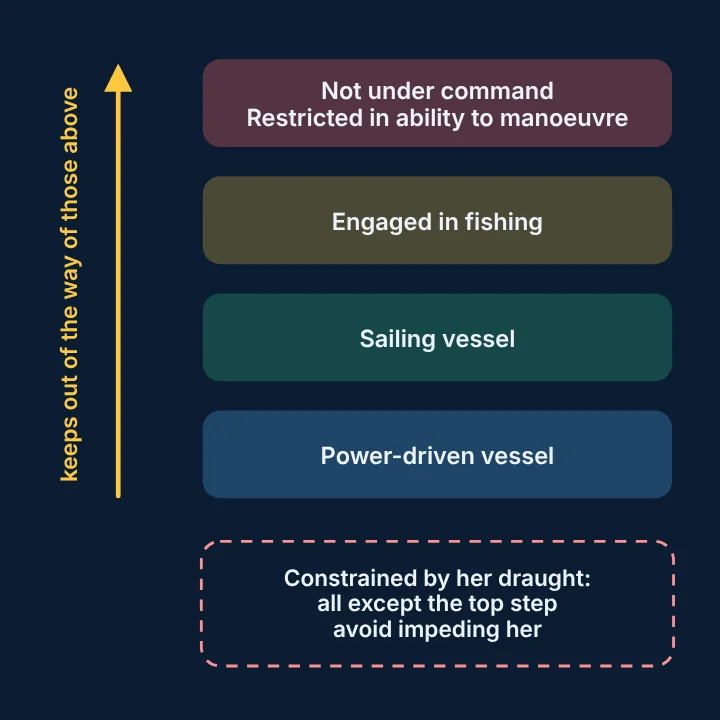
Rule 18 is the ladder: the vessel that can manoeuvre more easily keeps out of the way of the one that cannot. Power-driven gives way to sail, sail to fishing, fishing to vessels restricted in their ability to manoeuvre and not under command. Here is the ladder, the three rules that come before it, and where a deep ship fits in.
Rule 18, between vessels in sight of one another: each keeps out of the way of those above her. Overtaking (Rule 13), narrow channels (Rule 9) and traffic separation schemes (Rule 10) come first.
Quick facts
Power-driven
Underway, keeps out of the way of a vessel not under command, restricted in her ability to manoeuvre, engaged in fishing, and a sailing vessel (18(a)).
Sailing
Underway, keeps out of the way of a vessel not under command, restricted in her ability to manoeuvre, and engaged in fishing (18(b)).
Fishing
Underway, keeps out of the way, so far as possible, of a vessel not under command and restricted in her ability to manoeuvre (18(c)).
Constrained by draught
Every vessel except one not under command or restricted in her ability to manoeuvre shall, if the circumstances admit, avoid impeding her safe passage. She navigates with particular caution (18(d)).
Seaplane, WIG
A seaplane on the water in general keeps well clear of all vessels. A WIG craft taking off, landing or flying near the surface keeps well clear of all other vessels (18(e), (f)).
Comes first
Rule 18 applies "except where Rules 9, 10 and 13 otherwise require": narrow channels, traffic separation schemes and overtaking.
What the ladder is built on
Every step is about ability to manoeuvre, and every step is a status, not a type of ship. A trawler with her gear on deck is a power-driven vessel. A yacht with the engine running is a power-driven vessel. A dredger on passage is a power-driven vessel. The lights and shapes she shows tell you which step she is on right now.
Not under command and restricted in ability to manoeuvre share the top step. The Rules give no order between the two: each does what she can, and Rule 2 covers the rest.
Three rules above the ladder
Overtaking (Rule 13): any vessel overtaking keeps clear – a sailing vessel overtaking a ship, a vessel fishing overtaking a yacht.
Narrow channels (Rule 9): small craft, sailing vessels and vessels fishing shall not impede a ship that can only navigate within the channel.
Traffic separation schemes (Rule 10): vessels fishing shall not impede any vessel following a lane; small craft and sailing vessels shall not impede a power-driven vessel following a lane.
Constrained by her draught: beside the ladder, not on it
Nobody is told to "keep out of the way" of a vessel constrained by her draught. Others shall avoid impeding her: act early so that she never has to leave the deep water. If risk of collision develops anyway, the ordinary steering rules apply between the two – in a crossing with another power-driven vessel she may be the give-way vessel.
Only in sight
Rule 18 is in the section for vessels in sight of one another. In fog, with the other vessel on radar only, there is no ladder: Rule 19 applies to everyone, and the fog signal – one prolonged and two short – only tells you that she is one of the vessels that cannot manoeuvre freely.
Common mistakes
Ranking by type instead of status. "Fishing boat" and "yacht" are not steps on the ladder; "engaged in fishing" and "under sail only" are.
Forgetting overtaking. The ladder is switched off for the vessel that is overtaking.
Putting a vessel constrained by her draught on top. She is to be not impeded, which is a different and earlier duty, and vessels not under command or restricted in their ability to manoeuvre are excused it.
Placing not under command above restricted in ability to manoeuvre. The Rules do not rank the two.
Using the ladder on a radar target in fog. Not in sight means Rule 19.
Written by a serving chief officer and master mariner. Summaries in our own words – the official text is the COLREGs (IMO, 1972, as amended).
Test yourself
Question 1 of 8
These four vessels are in sight of one another in open water, and no one is overtaking. Rank them by Rule 18: the one with the most right of way first, the one that keeps out of the way of all the others last.
Power-drivenPower-driven vesselFishingEngaged in fishingNUCNot under commandSailingSailing vessel
Correct!Not quite. The answer is NUC → Fishing → Sailing → Power-driven.
Rule 18: a power-driven vessel keeps out of the way of NUC, RAM, fishing and sailing vessels. A sailing vessel keeps out of the way of NUC, RAM and fishing vessels. A vessel engaged in fishing keeps out of the way of NUC and RAM, so far as possible. Every vessel except NUC and RAM avoids impeding a vessel constrained by her draught – by acting early to leave her room; if risk of collision still develops, both follow the steering rules (Rule 8(f)). This order holds for vessels in sight of one another in open water – overtaking (Rule 13) and narrow channels or TSS (Rules 9 and 10) come first.
Question 2 of 8
You are on a power-driven vessel making way. At night you see these lights right ahead (001° relative). The compass bearing is steady and the range is closing. What do you do?
Relative bearing 001°
Correct!Not quite. The answer is Keep out of her way – she has priority over you under Rule 18.
She is: vessel engaged in fishing (not trawling), not making way. Rule 18(a): a power-driven vessel underway keeps out of the way of a vessel not under command, a vessel restricted in her ability to manoeuvre, a vessel engaged in fishing and a sailing vessel.
Relative bearing 001°
By day
Question 3 of 8
You are on a power-driven vessel making way. At night you see these lights on your starboard bow (023° relative). The compass bearing is steady and the range is closing. What do you do?
Relative bearing 023°
Correct!Not quite. The answer is Keep out of her way – she has priority over you under Rule 18.
She is: sailing vessel underway, with optional red over green. Rule 18(a): a power-driven vessel underway keeps out of the way of a vessel not under command, a vessel restricted in her ability to manoeuvre, a vessel engaged in fishing and a sailing vessel.
Relative bearing 023°
By day
Question 4 of 8
A sailing vessel underway shall keep out of the way of:
Correct!Not quite. The answer is A vessel engaged in fishing.
Rule 18(b): a sailing vessel underway shall keep out of the way of a vessel not under command, a vessel restricted in her ability to manoeuvre and a vessel engaged in fishing. (Rule 18(b))
Question 5 of 8
A vessel engaged in fishing, underway, shall so far as possible keep out of the way of:
Correct!Not quite. The answer is A vessel not under command and a vessel restricted in her ability to manoeuvre.
Rule 18(c): a vessel engaged in fishing when underway shall, so far as possible, keep out of the way of (i) a vessel not under command and (ii) a vessel restricted in her ability to manoeuvre. (Rule 18(c))
Question 6 of 8
Which vessels shall, if the circumstances admit, avoid impeding the safe passage of a vessel constrained by her draught?
Correct!Not quite. The answer is Any vessel other than one not under command or restricted in her ability to manoeuvre.
Rule 18(d)(i): any vessel other than a vessel not under command or a vessel restricted in her ability to manoeuvre shall, if the circumstances of the case admit, avoid impeding the safe passage of a vessel constrained by her draught, exhibiting the signals in Rule 28. (Rule 18(d))
Question 7 of 8
A seaplane on the water shall in general:
Correct!Not quite. The answer is Keep well clear of all vessels and avoid impeding their navigation.
Rule 18(e): a seaplane on the water shall, in general, keep well clear of all vessels and avoid impeding their navigation. Where risk of collision exists, she shall comply with the Rules of Part B. (Rule 18(e))
Question 8 of 8
A sailing vessel is overtaking a power-driven vessel. Who keeps out of the way?
Correct!Not quite. The answer is The sailing vessel – she is overtaking.
Rule 13(a): notwithstanding anything in Rules 4–18, any vessel overtaking any other shall keep out of the way of the vessel being overtaken. Rule 18 does not change that. (Rule 13(a))
You have right out of answered.The app draws every question new: other angles, other light, other wrong answers.
Learn it until you see it in your sleep
Lanterna draws every vessel from the rules, from every angle, in changing light and weather, and asks until you know her. Lights and shapes, COLREGs with "what do you do?" situations, buoyage, sound signals, flags, VHF and Morse. Works offline.
Free round of ten questions in every category, then everything with a single purchase. Lanterna is independent and not affiliated with the IMO or any maritime authority.