The lights of a power-driven vessel and a yellow light flashing on top: a hovercraft riding on her cushion. Here is what she shows, what the flashing light is for, and how a WIG craft differs. COLREG Rule 23(b) and (c).
Seen from aheadFrom her starboard sideFrom asternFrom her port bow
Quick facts
At night
The lights of a power-driven vessel – masthead light, sidelights, sternlight – and an all-round flashing yellow light.
Only when
She is operating in the non-displacement mode, on her cushion. Afloat like a boat she shows ordinary lights only.
Flashing
In the Rules a flashing light flashes 120 times or more per minute (Rule 21(f)).
By day
No shape.
In fog
As a power-driven vessel: one prolonged blast making way, two when stopped (Rule 35(a) and (b)).
Who keeps clear
She is a power-driven vessel under Rule 18, with no special rights and no special duties.
Why the yellow light matters
On her cushion a hovercraft is fast and has no grip in the water. In a cross wind she can travel at a large angle to the way she is pointing, so her sidelights and masthead light may show you one aspect while she moves in another direction.
The flashing yellow light is the warning: do not judge her course from her lights. Watch the bearing instead.
WIG craft: flashing red
A wing-in-ground craft shows the lights of a power-driven vessel and, only when taking off, landing and in flight near the surface, a high-intensity all-round flashing red light (Rule 23(c)). In that phase she keeps well clear of all other vessels and avoids impeding their navigation (Rule 18(f)).
Common mistakes
Taking the yellow light for a towing light. A towing light is steady, shows only astern and sits above a sternlight. This one flashes all round.
Judging her course from her sidelights. She may be moving sideways.
Expecting the flashing light whenever she is underway. Off the cushion, in the displacement mode, she shows only ordinary lights.
Mixing up the colours: flashing yellow is the air-cushion vessel, flashing red is the WIG craft.
Written by a serving chief officer and master mariner. Summaries in our own words – the official text is the COLREGs (IMO, 1972, as amended).
Test yourself
Question 1 of 7
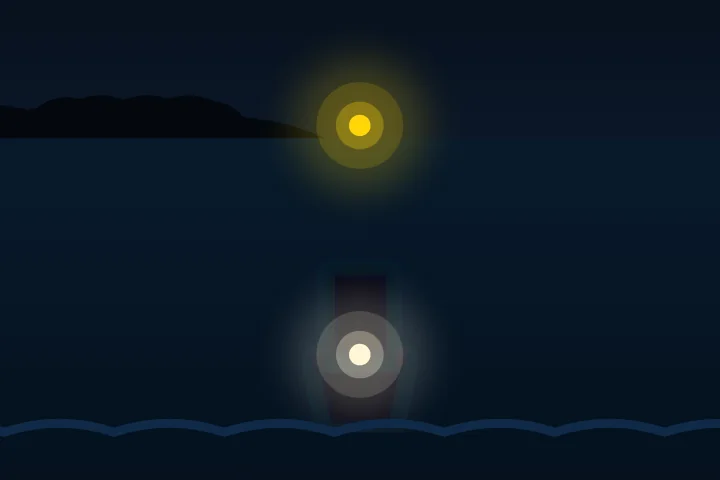
At night you see these lights. What is it?
Correct!Not quite. The answer is Air-cushion vessel (hovercraft).
In the non-displacement mode: the lights of a power-driven vessel plus an all-round flashing yellow light. You are on her starboard quarter. Rule 23(b)
By day
Question 2 of 7
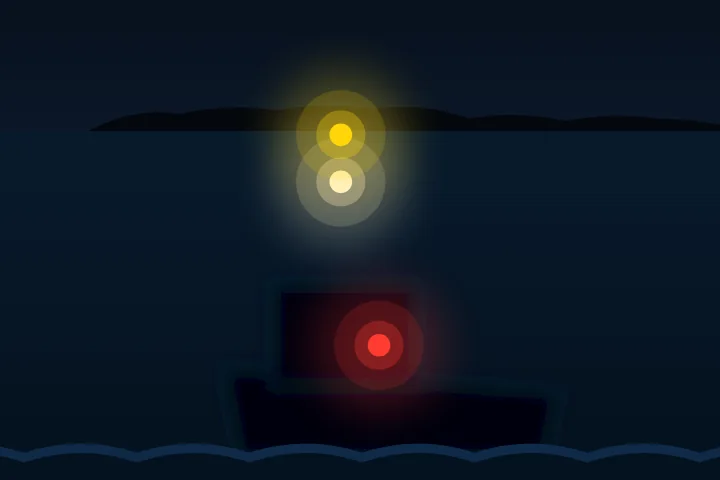
At night you see these lights. What is it?
Correct!Not quite. The answer is Air-cushion vessel (hovercraft).
In the non-displacement mode: the lights of a power-driven vessel plus an all-round flashing yellow light. You are on her starboard bow. Rule 23(b)
By day
Question 3 of 7
This is an air-cushion vessel (hovercraft), at night, and you are right ahead of her. One light is missing where the ring is. What should be there?
Correct!Not quite. The answer is All-round flashing yellow light.
In the non-displacement mode: the lights of a power-driven vessel plus an all-round flashing yellow light. Rule 23(b)
Question 4 of 7
An air-cushion vessel operating in the non-displacement mode shows, in addition to the lights of a power-driven vessel:
Correct!Not quite. The answer is An all-round flashing yellow light.
Rule 23(b): an air-cushion vessel in the non-displacement mode shall, in addition to the lights in Rule 23(a), exhibit an all-round flashing yellow light. (Rule 23(b))
Question 5 of 7
A WIG craft taking off, landing or in flight near the surface shows, in addition to the lights of a power-driven vessel:
Correct!Not quite. The answer is A high-intensity all-round flashing red light.
Rule 23(c): a WIG craft only when taking off, landing and in flight near the surface shall, in addition to the lights in Rule 23(a), exhibit a high-intensity all-round flashing red light. (Rule 23(c))
Question 6 of 7
A "flashing light" in the Rules flashes at regular intervals at a frequency of:
Correct!Not quite. The answer is 120 flashes or more per minute.
Rule 21(f): a flashing light is a light flashing at regular intervals at a frequency of 120 flashes or more per minute. (Rule 21(f))
Question 7 of 7
A WIG craft taking off, landing or in flight near the surface shall:
Correct!Not quite. The answer is Keep well clear of all other vessels and avoid impeding their navigation.
Rule 18(f)(i): a WIG craft when taking off, landing and in flight near the surface shall keep well clear of all other vessels and avoid impeding their navigation. On the water surface she complies with the Rules as a power-driven vessel. (Rule 18(f))
You have right out of answered.The app draws every question new: other angles, other light, other wrong answers.
Learn it until you see it in your sleep
Lanterna draws every vessel from the rules, from every angle, in changing light and weather, and asks until you know her. Lights and shapes, COLREGs with "what do you do?" situations, buoyage, sound signals, flags, VHF and Morse. Works offline.
Free round of ten questions in every category, then everything with a single purchase. Lanterna is independent and not affiliated with the IMO or any maritime authority.