The number of masthead lights in a vertical line tells you how long the tow is. Here is what a tug and her tow show from ahead and astern, when a diamond goes up by day, and why towing alone gives no right of way. COLREG Rule 24.
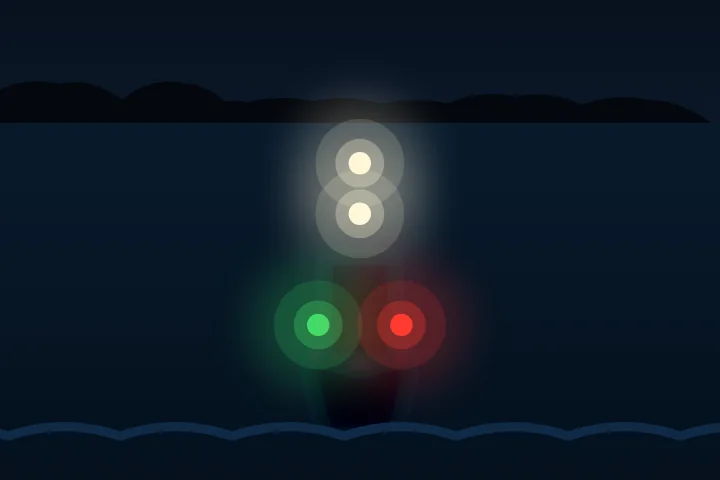
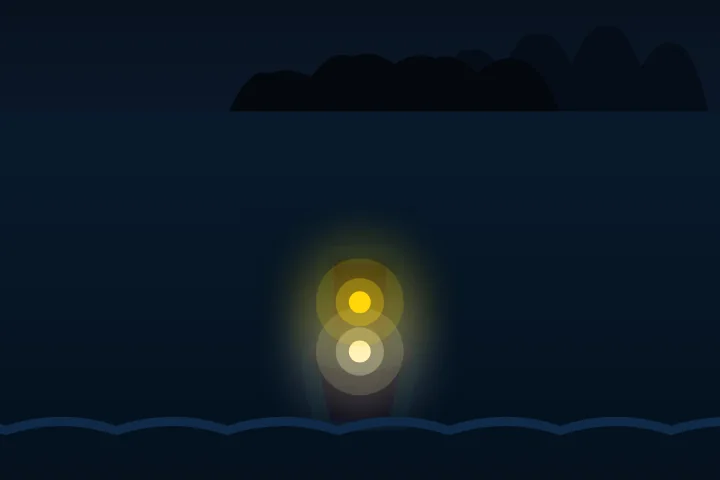
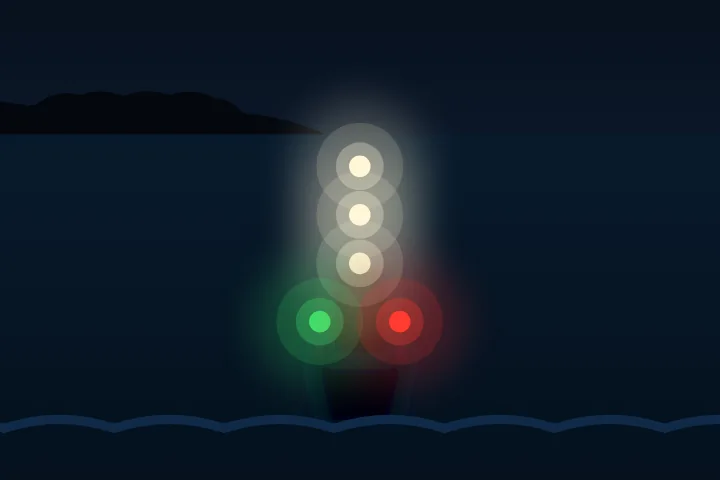
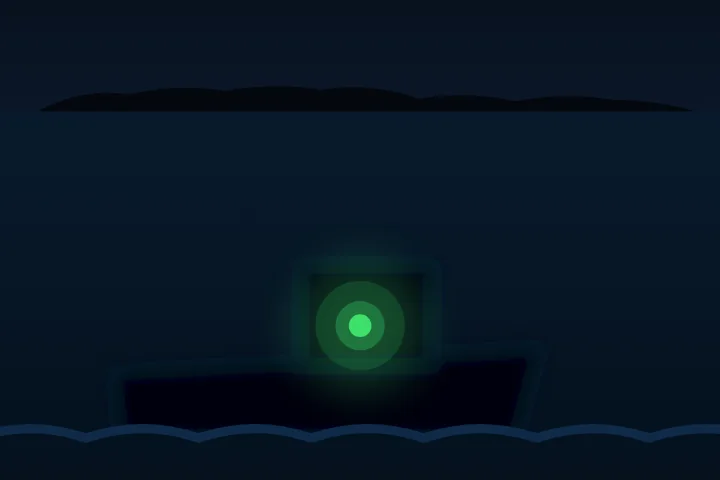
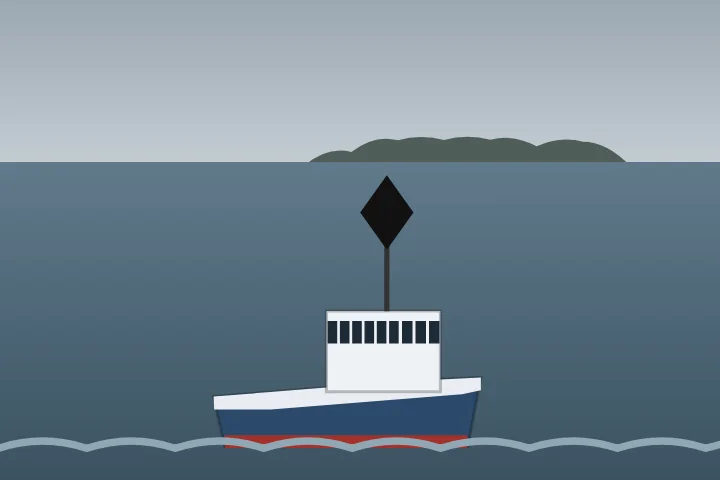
Tow 200 m or less, seen from ahead: two masthead lightsFrom astern: yellow towing light over the sternlightTow over 200 m: three masthead lightsThe tow from her starboard side: just a green sidelightBy day, tow over 200 m: a diamond
Quick facts
Tow 200 m or less
Two masthead lights in a vertical line, sidelights, sternlight and a yellow towing light above the sternlight.
Tow over 200 m
Three masthead lights in a vertical line, and by day a diamond on both tug and tow.
Length of the tow
Measured from the stern of the towing vessel to the after end of the tow.
The tow
Sidelights and a sternlight (and the diamond when the tow is over 200 m).
Pushing or alongside
Two masthead lights, sidelights and a sternlight – no towing light. A rigid pushing unit shows the lights of one power-driven vessel.
In fog
The tug: one prolonged and two short blasts. The last vessel of the tow, if manned: one prolonged and three short, right after the tug's signal (Rule 35(c) and (e)).
Towing gives no right of way by itself
A tug towing is a power-driven vessel. Rule 18 does not mention towing, so in a crossing she gives way like anyone else. Only when the tow severely restricts both tug and tow does she add red, white, red (Rule 27(c)) – then she is restricted in her ability to manoeuvre.
Counting the white lights
The masthead lights in one vertical line can be carried forward or aft. A tug of 50 m or more also shows her other masthead light, so you may see three whites – but only two or three of them in one vertical line. Count the vertical line, not all the whites.
Common mistakes
Giving way to a tug just because she is towing. Without red-white-red she is a power-driven vessel.
Crossing between tug and tow. The tow line can be long and low in the water: look for the tow's sidelights and sternlight behind the tug.
Looking for the yellow light ahead. The towing light is above the sternlight, so you only see it from astern.
Expecting a towing light when she pushes ahead or tows alongside. Then there is none.
Written by a serving chief officer and master mariner. Summaries in our own words – the official text is the COLREGs (IMO, 1972, as amended).
Test yourself
Question 1 of 6
At night you see these lights. What is it?
Correct!Not quite. The answer is Power-driven vessel towing, tow 200 m or less.
Two masthead lights in a vertical line, sidelights, sternlight and a yellow towing light above the sternlight. You are on her port beam. She is towing astern. Rule 24(a)
By day
Question 2 of 6
At night: which picture shows a power-driven vessel towing, tow over 200 m?
Correct!Not quite. The answer is Power-driven vessel towing, tow over 200 m (towing astern).
Three masthead lights in a vertical line, sidelights, sternlight and a yellow towing light. By day a diamond. In the right picture you are right ahead of her. Rule 24(a)
Question 3 of 6
By day you see this. What is it?
Correct!Not quite. The answer is Vessel being towed.
Sidelights and a sternlight. By day a diamond where it can best be seen when the tow is longer than 200 m. You are on her port beam. The tow is over 200 m. Rule 24(e) By day, the same shapes are shown by: power-driven vessel towing, tow over 200 m.
At night
Question 4 of 6
What is a "towing light"?
Correct!Not quite. The answer is A yellow light with the same characteristics as the sternlight (135°).
Rule 21(d): a towing light is a yellow light having the same characteristics as the sternlight. (Rule 21(d))
Question 5 of 6
A power-driven vessel pushing ahead or towing alongside (not a composite unit) shows:
Correct!Not quite. The answer is Two masthead lights in a vertical line, sidelights and a sternlight.
Rule 24(c): two masthead lights in a vertical line, sidelights and a sternlight. The yellow towing light is only for towing astern, and it shows only over the arc of the sternlight – so from anywhere forward of 22.5° abaft her beam she looks just like a vessel towing astern with a tow of 200 m or less (two masthead lights). (Rule 24(c))
Question 6 of 6
A towing vessel and her tow are severely restricted in their ability to deviate from their course. In addition to the towing lights she shows:
Correct!Not quite. The answer is All-round red, white, red in a vertical line (by day ball, diamond, ball).
Rule 27(c): in addition to the lights or shapes of Rule 24(a), she shows the lights or shapes of Rule 27(b)(i) and (ii): red, white, red / ball, diamond, ball. (Rule 27(c))
You have right out of answered.The app draws every question new: other angles, other light, other wrong answers.
Learn it until you see it in your sleep
Lanterna draws every vessel from the rules, from every angle, in changing light and weather, and asks until you know her. Lights and shapes, COLREGs with "what do you do?" situations, buoyage, sound signals, flags, VHF and Morse. Works offline.
Free round of ten questions in every category, then everything with a single purchase. Lanterna is independent and not affiliated with the IMO or any maritime authority.