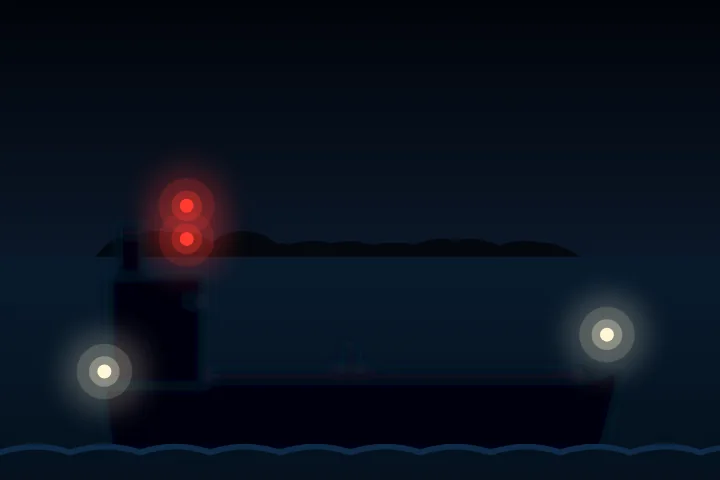
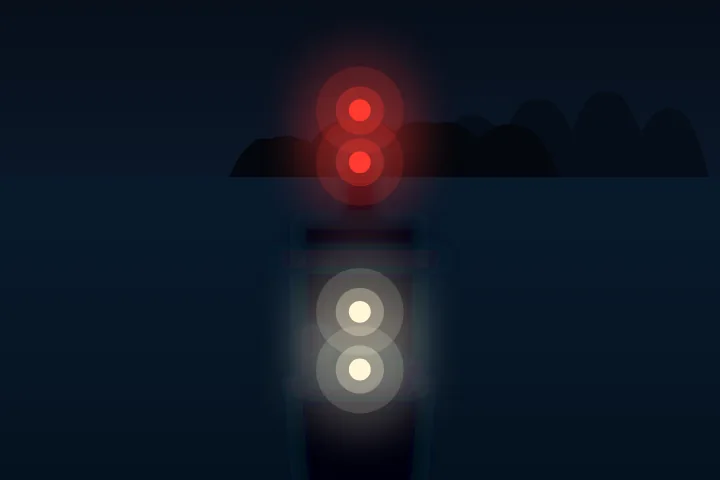
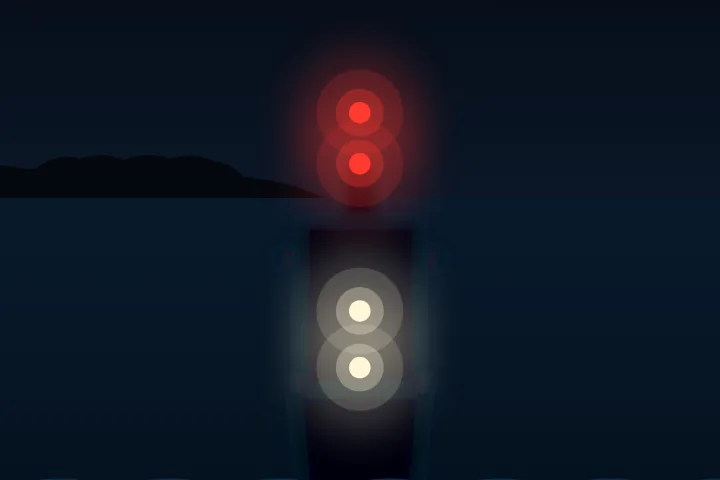
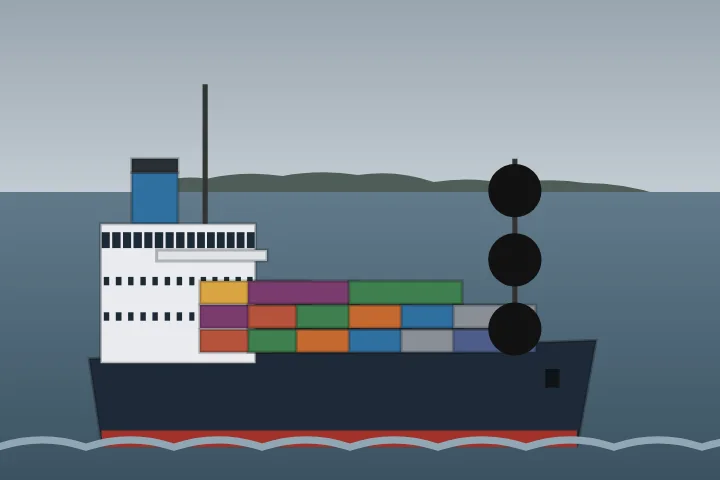
Anchor lights with two reds above the deck: she is aground, and the water where she lies is too shallow for you too. Here is what she shows by night, by day and in fog, and how to tell her from a vessel not under command. COLREG Rule 30(d).
Aground, from her starboard side: anchor lights and two redsSeen from aheadSeen from asternBy day: three balls in a vertical line
Quick facts
At night
The anchor light or lights for her length, and two all-round red lights in a vertical line.
By day
Three balls in a vertical line.
Not shown
No sidelights, no sternlight, no masthead lights – she is not underway.
In fog
The bell as at anchor (and the gong if 100 m or more), with three separate and distinct strokes on the bell just before and just after the rapid ringing. She may also sound a suitable whistle signal (Rule 35(h)).
Small craft
A vessel under 12 m does not have to show the two reds or the three balls (Rule 30(f)).
Aground or not under command?
Both show two all-round reds. The difference is everything else: a vessel aground shows white anchor lights and never sidelights. A vessel not under command shows no anchor lights, and sidelights and a sternlight when she is making way.
By day there is no doubt: two balls is not under command, three balls is aground.
What she is telling you
She cannot move, so keeping clear is up to you – and where she has touched bottom there is not much water for the next ship either. The whistle signal the Rules allow her can for example be the letter U of the International Code (two short and one prolonged): "you are running into danger".
Aground is not a distress signal. If she needs help she uses the signals of Annex IV as well.
Common mistakes
Calling her "not under command" because of the two reds. Look for the white anchor lights: with them she is aground.
Mixing her up with a vessel constrained by her draught. That is three reds over the lights of a ship underway; aground is two reds and no sidelights.
Three balls or two? Three in a vertical line is aground. Three balls in a triangle is mine clearance.
Passing close to have a look. The shoal that stopped her is still there.
Written by a serving chief officer and master mariner. Summaries in our own words – the official text is the COLREGs (IMO, 1972, as amended).
Test yourself
Question 1 of 7
By day: which picture shows a vessel aground?
Correct!Not quite. The answer is Vessel aground.
Anchor lights plus two all-round red lights in a vertical line. By day three balls. In the right picture you are on her port bow. Rule 30(d)
Question 2 of 7
At night you see these lights. What is it?
Correct!Not quite. The answer is Vessel aground.
Anchor lights plus two all-round red lights in a vertical line. By day three balls. You are on her starboard beam. She is aground. Rule 30(d)
By day
Question 3 of 7
This is a vessel aground. At night she shows these lights, and you are on her starboard bow. What is wrong?
Correct!Not quite. The answer is She should show: red over red (all-round lights).
She shows red (all-round lights) but should show red over red (all-round lights). Anchor lights plus two all-round red lights in a vertical line. By day three balls. Rule 30(d)
Question 4 of 7
This is a vessel aground, at night, and you are on her port bow. One light is missing where the ring is. What should be there?
Correct!Not quite. The answer is All-round white light.
Anchor lights plus two all-round red lights in a vertical line. By day three balls. Rule 30(d)
Question 5 of 7
You are on a power-driven vessel making way. At night you see these lights right ahead (357° relative). The compass bearing is steady and the range is closing. What do you do?
Relative bearing 357°
Correct!Not quite. The answer is She is aground – keep well clear of the shallows.
She is: vessel aground. She is aground, not underway: no give-way situation, but keep well clear – the water there is too shallow. Her lights and shapes: Rule 30(d).
Relative bearing 357°
By day
Question 6 of 7
A vessel aground in fog gives the anchor bell (and gong) signal and, in addition:
Correct!Not quite. The answer is Three separate and distinct strokes on the bell immediately before and after the rapid ringing.
Rule 35(h): a vessel aground shall give the bell signal and if required the gong signal of 35(g) and shall, in addition, give three separate and distinct strokes on the bell immediately before and after the rapid ringing of the bell. (Rule 35(h))
Question 7 of 7
At night you see these lights. What is it?
Correct!Not quite. The answer is Vessel not under command.
Two all-round red lights in a vertical line. Sidelights and sternlight when making way. By day two balls. You are on her starboard quarter. She is not making way. Rule 27(a)
By day
You have right out of answered.The app draws every question new: other angles, other light, other wrong answers.
Learn it until you see it in your sleep
Lanterna draws every vessel from the rules, from every angle, in changing light and weather, and asks until you know her. Lights and shapes, COLREGs with "what do you do?" situations, buoyage, sound signals, flags, VHF and Morse. Works offline.
Free round of ten questions in every category, then everything with a single purchase. Lanterna is independent and not affiliated with the IMO or any maritime authority.