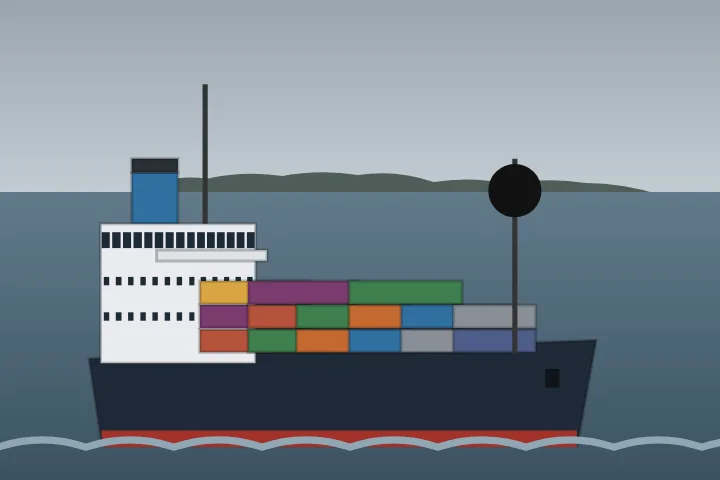
One white light, or two with the forward one higher, and no sidelights: a vessel at anchor. Here is what she shows by length, by day and in fog, and how to tell her from a ship that is only stopped. COLREG Rule 30.
50 m or more: forward light higher than the after one50 m or more, seen from aheadLess than 50 m: one all-round white lightBy day: one ball in the fore part
Quick facts
Less than 50 m
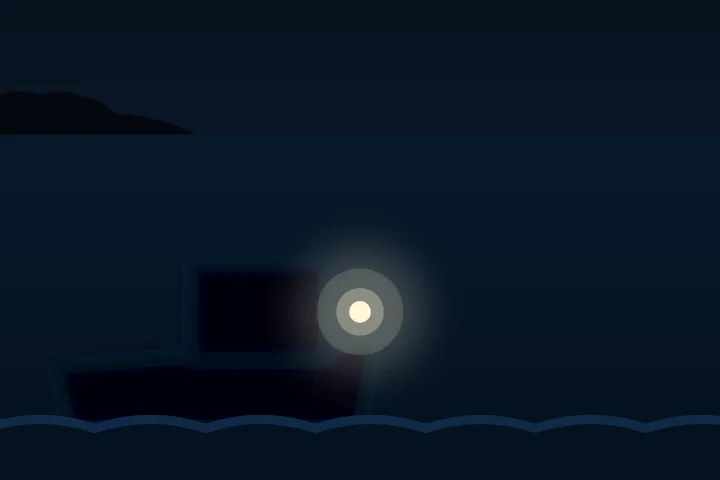
One all-round white light where it can best be seen. She may show two, like a larger ship.
50 m or more
An all-round white light in the fore part and a second at or near the stern, lower than the forward one.
100 m or more
She shall also light up her decks with her working lights. Smaller vessels may (Rule 30(c)).
By day
One ball in the fore part.
In fog
The bell rung rapidly for about 5 seconds every minute; 100 m or more also the gong aft. To warn an approaching vessel she may add one short, one prolonged and one short blast (Rule 35(g)).
Small craft
Under 7 m, and not in or near a narrow channel, fairway, anchorage or where other vessels normally navigate: no anchor light or ball required (Rule 30(e)).
At anchor, or only stopped?
A vessel is underway whenever she is not at anchor, made fast to the shore or aground (Rule 3(i)). A ship lying stopped and drifting is underway: she keeps her masthead lights, sidelights and sternlight, and in fog she sounds two prolonged blasts, not the bell.
A vessel at anchor shows no sidelights and no sternlight. That is the quickest way to tell: white lights and deck lights, but nothing red or green.
Which way is she lying?
On a ship underway the after masthead light is the higher one. At anchor it is the other way round: the forward light is higher. Two whites with the higher one to the left means her bow is to the left.
Vessels that do not show anchor lights at anchor
A vessel engaged in fishing shows only her fishing lights, also when she is anchored with her gear out (Rule 26(a)). A dredger with an obstruction shows her red and green lights instead of the anchor lights (Rule 27(d)). A vessel restricted in her ability to manoeuvre shows red, white, red and the anchor lights.
Common mistakes
Taking a single white light for a sternlight – or the other way round. Watch the bearing and the range: a sternlight moves, an anchor light stays on the chart.
Expecting the after light to be higher, as on a ship underway. At anchor the forward light is the higher one.
Calling a stopped ship "at anchor". Stopped and drifting is underway: sidelights on, two prolonged blasts in fog.
Sounding one prolonged blast at anchor in fog. An ordinary vessel at anchor rings the bell; her whistle is only for the optional short, prolonged, short warning.
Leaving the ball down by day. The anchor ball is as compulsory as the light.
Written by a serving chief officer and master mariner. Summaries in our own words – the official text is the COLREGs (IMO, 1972, as amended).
Test yourself
Question 1 of 8
By day you see this. What is it?
Correct!Not quite. The answer is Vessel at anchor.
All-round white light(s): two if 50 m or more (the forward one higher); a vessel under 50 m may show one instead. By day one ball. You are on her port beam. She is 50 m or more. Rule 30(a)
At night
Question 2 of 8
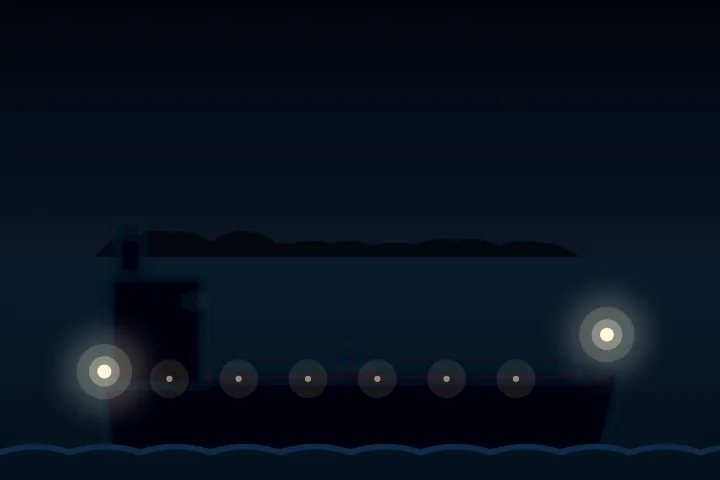
At night you see these lights. What is it?
Correct!Not quite. The answer is Vessel at anchor.
All-round white light(s): two if 50 m or more (the forward one higher); a vessel under 50 m may show one instead. By day one ball. You are on her starboard quarter. She is 50 m or more. Rule 30(a)
By day
Question 3 of 8
This is a vessel at anchor, less than 50 m. By day she shows these shapes. What is wrong?
Correct!Not quite. The answer is She should show: ball (top to bottom).
She shows cylinder, ball (top to bottom) but should show ball (top to bottom). All-round white light(s): two if 50 m or more (the forward one higher); a vessel under 50 m may show one instead. By day one ball. Rule 30(a)
Question 4 of 8
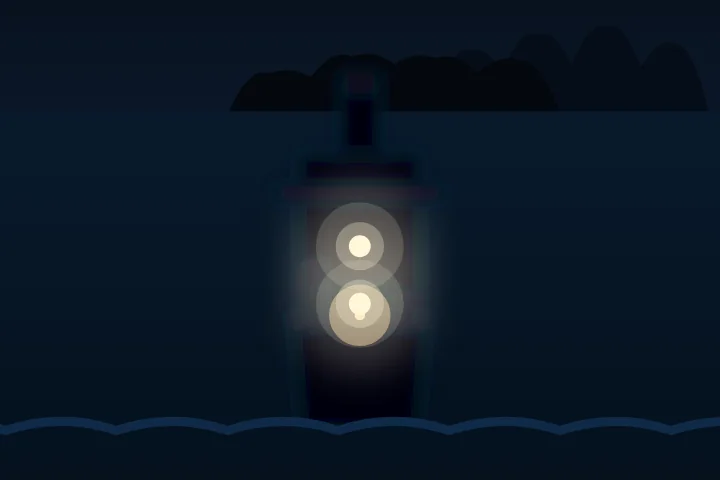
This is a vessel at anchor, 50 m or more, at night, and you are right ahead of her. One light is missing where the ring is. What should be there?
Correct!Not quite. The answer is All-round white light.
All-round white light(s): two if 50 m or more (the forward one higher); a vessel under 50 m may show one instead. By day one ball. Rule 30(a)
Question 5 of 8
Which vessels at anchor SHALL use their working lights to illuminate their decks?
Correct!Not quite. The answer is Vessels of 100 m or more.
Rule 30(c): a vessel at anchor may, and a vessel of 100 m or more shall, also use the available working or equivalent lights to illuminate her decks. (Rule 30(c))
Question 6 of 8
When is a vessel "underway"?
Correct!Not quite. The answer is When she is not at anchor, made fast to the shore or aground.
Rule 3(i): the word "underway" means that a vessel is not at anchor, or made fast to the shore, or aground. A vessel can be underway but not making way. (Rule 3(i))
Question 7 of 8
How does a vessel at anchor in fog ring her bell?
Correct!Not quite. The answer is Rapidly for about 5 seconds, at intervals of not more than 1 minute.
Rule 35(g): a vessel at anchor shall at intervals of not more than one minute ring the bell rapidly for about 5 seconds. (Rule 35(g))
Question 8 of 8
A vessel of 12 m or more but less than 20 m at anchor in fog:
Correct!Not quite. The answer is Need not give the bell signal, but if she does not, shall make some other efficient sound signal at intervals of not more than 2 minutes.
Rule 35(i): a vessel of 12 metres or more but less than 20 metres shall not be obliged to give the bell signals in 35(g) and (h). However, if she does not, she shall make some other efficient sound signal at intervals of not more than 2 minutes. (Rule 35(i))
You have right out of answered.The app draws every question new: other angles, other light, other wrong answers.
Learn it until you see it in your sleep
Lanterna draws every vessel from the rules, from every angle, in changing light and weather, and asks until you know her. Lights and shapes, COLREGs with "what do you do?" situations, buoyage, sound signals, flags, VHF and Morse. Works offline.
Free round of ten questions in every category, then everything with a single purchase. Lanterna is independent and not affiliated with the IMO or any maritime authority.