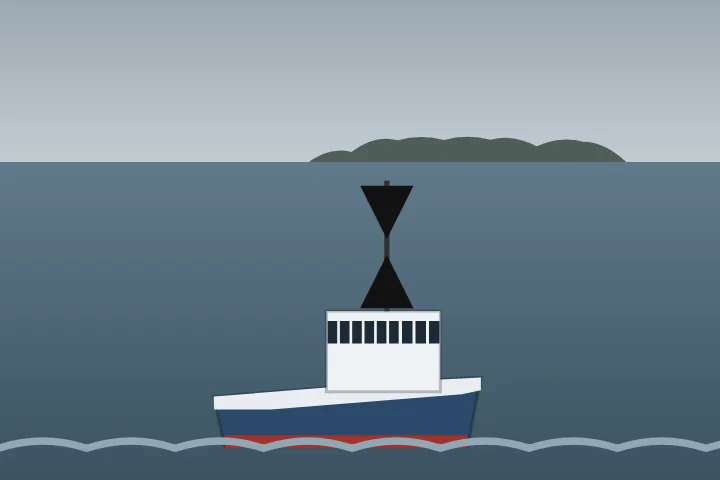
A vessel dragging a trawl shows green over white. Here is what you see from ahead, from the side and from astern, what she shows by day and in fog, and the mistakes examiners look for. COLREG Rule 26(b).
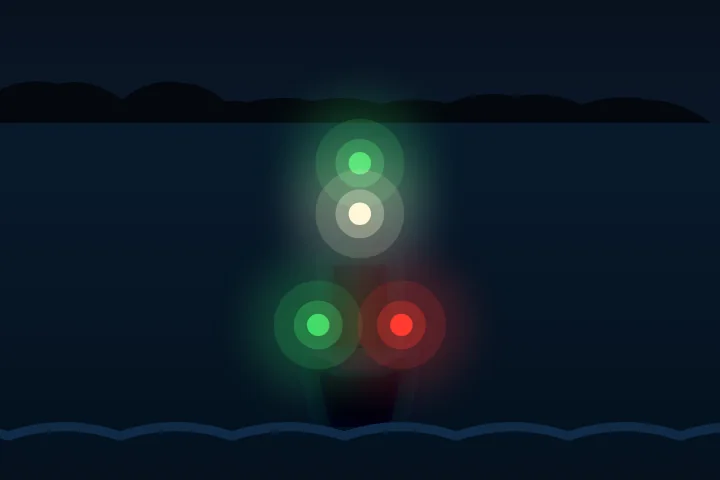
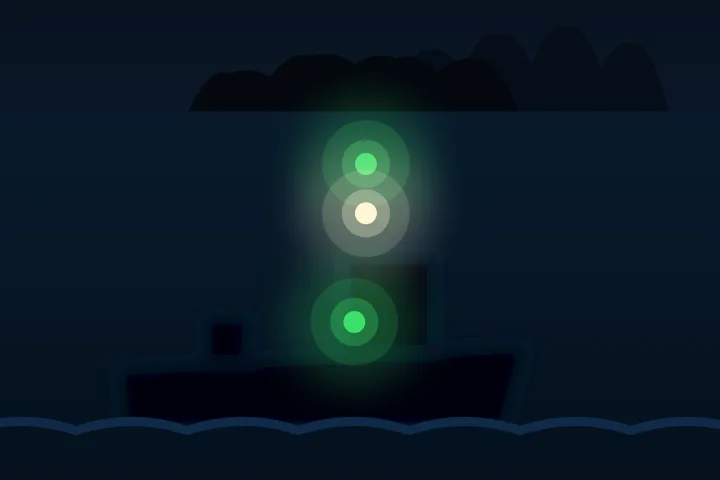
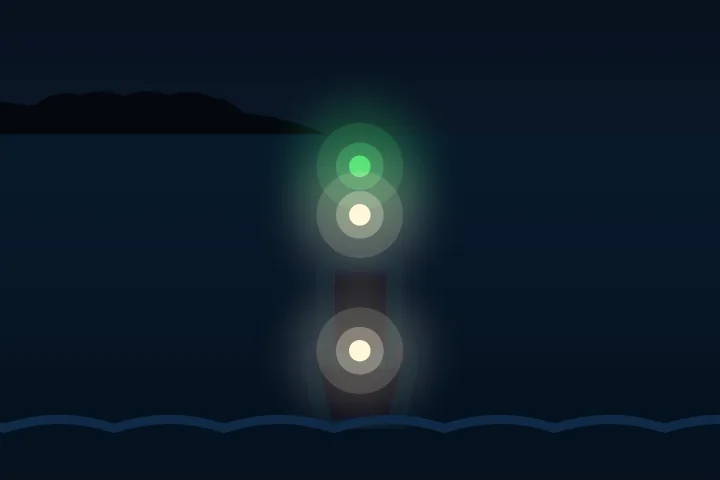
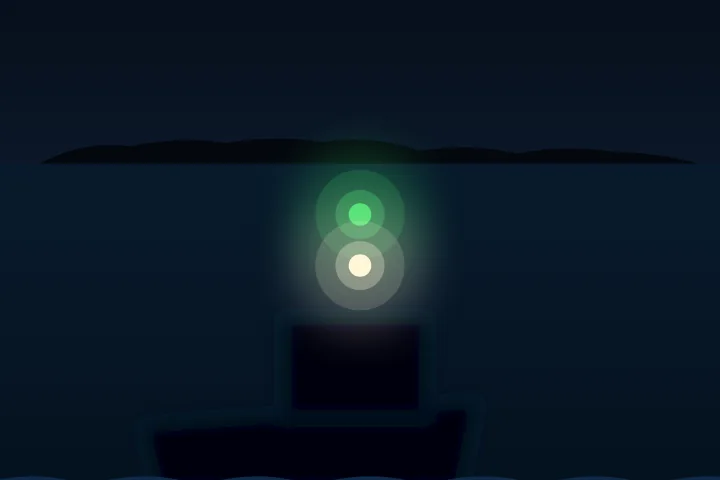
Making way, seen from aheadMaking way, from her starboard sideMaking way, from asternNot making way: no sidelights, no sternlightBy day: two cones, points together
Quick facts
At night
Two all-round lights in a vertical line, green over white.
Masthead light
A trawler of 50 m or more also shows a masthead light abaft of and higher than the green light. Under 50 m she may.
Making way
Sidelights and a sternlight as well. Stopped in the water: only the all-round lights (and the masthead light).
By day
Two cones with their points together, one above the other. Under 20 m she may show a basket instead.
In fog
One prolonged followed by two short blasts, at intervals of not more than 2 minutes – also at anchor (Rule 35(c) and (d)).
Who keeps clear
Power-driven and sailing vessels keep out of her way (Rule 18). She keeps out of the way of a vessel not under command or restricted in her ability to manoeuvre, and shall not impede vessels in a narrow channel or a traffic lane (Rules 9 and 10).
What "engaged in trawling" means
The lights say that her gear is in the water, not that she is a fishing vessel. A trawler on her way to the fishing grounds with the trawl on deck is an ordinary power-driven vessel and shows ordinary lights (Rule 26(e)).
The trawl can be several hundred metres astern of her and deep down. Give her a wide berth, and never pass close astern.
Extra lights when trawlers work close together
Annex II gives trawlers fishing near each other extra lights, below the green over white: two whites when shooting the nets, white over red when hauling, and two reds when the net has come fast on an obstruction. In pair trawling each vessel may also shine a searchlight forward towards the other one.
Common mistakes
Reading green over white as a pilot vessel. A pilot vessel shows white over red: other colours, other order. "Green over white, trawling tonight. White over red, pilot ahead."
Expecting a masthead light. Under 50 m she does not have to show one, so a small trawler seen from ahead may show nothing but green over white and her sidelights.
Thinking she is not fishing because the sidelights are off. Green over white without sidelights means trawling and stopped in the water – the gear is still out.
Crossing between two trawlers working as a pair. They may be towing one net between them.
Written by a serving chief officer and master mariner. Summaries in our own words – the official text is the COLREGs (IMO, 1972, as amended).
Test yourself
Question 1 of 6
At night: which picture shows a vessel engaged in trawling?
Correct!Not quite. The answer is Vessel engaged in trawling (not making way).
All-round green over white. Sidelights and sternlight only when making way. By day two cones, points together. In the right picture you are right ahead of her. Rule 26(b)
Question 2 of 6
By day you see this. What is it?
Correct!Not quite. The answer is Vessel engaged in trawling.
All-round green over white. Sidelights and sternlight only when making way. By day two cones, points together. You are on her starboard quarter. She is making way. Rule 26(b) By day, the same shapes are shown by: vessel engaged in fishing (not trawling).
At night
Question 3 of 6
This is a vessel engaged in trawling, not making way. At night she shows these lights, and you are on her port bow. What is wrong?
Correct!Not quite. The answer is Nothing is wrong – she shows the right signals.
Nothing is wrong. All-round green over white. Sidelights and sternlight only when making way. By day two cones, points together. Rule 26(b)
Question 4 of 6
A trawler of 50 m or more shall also show:
Correct!Not quite. The answer is A masthead light abaft of and higher than the all-round green light.
Rule 26(b)(ii): a masthead light abaft of and higher than the all-round green light. A vessel of less than 50 m is not obliged to, but may. (Rule 26(b))
Question 5 of 6
Annex II: a trawler fishing close to other fishing vessels shows two white lights in a vertical line, in addition to her trawling lights. What is she doing?
Correct!Not quite. The answer is Shooting her nets.
Annex II 2(a): vessels of 20 m or more engaged in trawling may exhibit (i) when shooting their nets: two white lights in a vertical line; (ii) when hauling: one white light over one red light; (iii) when the net has come fast upon an obstruction: two red lights. (COLREG Annex II 2(a))
Question 6 of 6
You are on a power-driven vessel making way. At night you see these lights right ahead (001° relative). The compass bearing is steady and the range is closing. What do you do?
Relative bearing 001°
Correct!Not quite. The answer is Keep out of her way – she has priority over you under Rule 18.
She is: vessel engaged in trawling, not making way. Rule 18(a): a power-driven vessel underway keeps out of the way of a vessel not under command, a vessel restricted in her ability to manoeuvre, a vessel engaged in fishing and a sailing vessel.
Relative bearing 001°
By day
You have right out of answered.The app draws every question new: other angles, other light, other wrong answers.
Learn it until you see it in your sleep
Lanterna draws every vessel from the rules, from every angle, in changing light and weather, and asks until you know her. Lights and shapes, COLREGs with "what do you do?" situations, buoyage, sound signals, flags, VHF and Morse. Works offline.
Free round of ten questions in every category, then everything with a single purchase. Lanterna is independent and not affiliated with the IMO or any maritime authority.