Vessel engaged in mine clearance: lights and day shapes
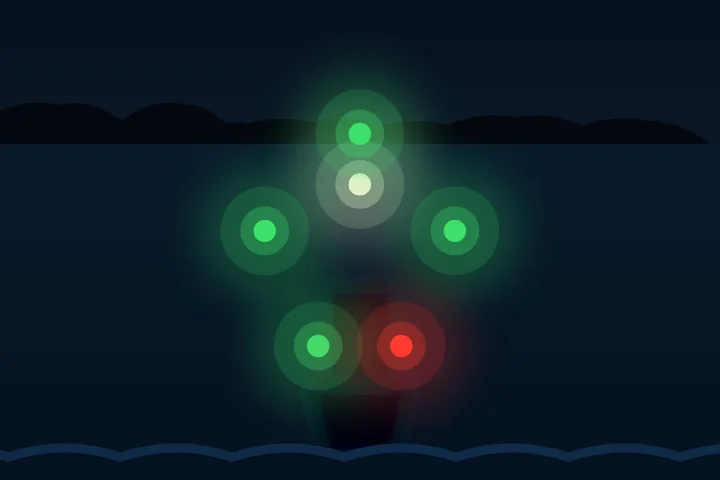
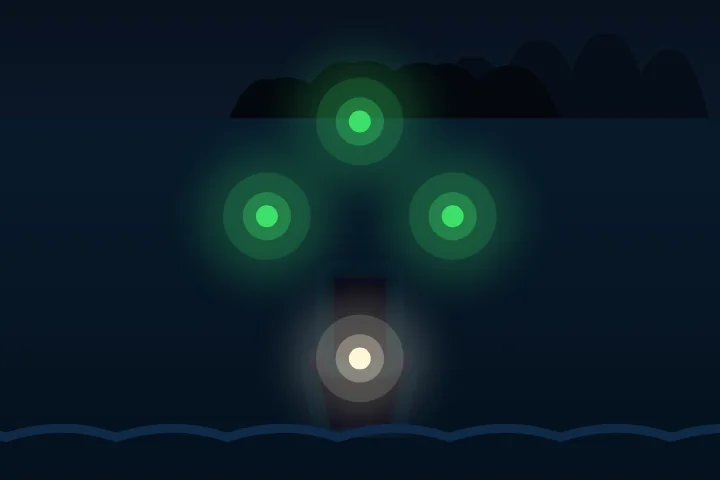
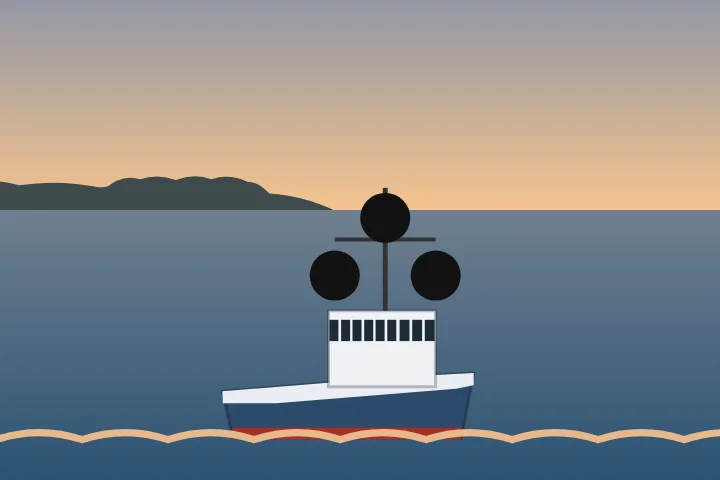
Three green lights in a triangle, one at the foremast head and one at each end of the yard: mine clearance. It is the only signal in the Rules that comes with a distance – 1,000 metres. COLREG Rule 27(f).
Seen from ahead: three greens over the lights of a power-driven vesselSeen from asternBy day: three balls, at the masthead and each yardarm
Quick facts
At night
Three all-round green lights: one near the foremast head and one at each end of the fore yard. Under them the lights of a power-driven vessel, or the anchor lights if she is anchored.
By day
Three balls in the same three places.
Keep away
It is dangerous for another vessel to approach within 1,000 metres of her.
Not shown
No red, white, red. Mine clearance is the one kind of restricted vessel with a signal of her own.
In fog
One prolonged followed by two short blasts, at intervals of not more than 2 minutes (Rule 35(c)).
Who keeps clear
She is restricted in her ability to manoeuvre (Rule 3(g)): power-driven, sailing and fishing vessels keep out of her way (Rule 18).
1,000 metres, all round
The distance is not only astern of her. Sweeps and remotely operated vehicles can be out on either side, and what she is looking for can be anywhere near her. A thousand metres is a little over half a nautical mile – on the radar, keep her inside nothing smaller than the 0.5 mile ring and stay outside it.
Three greens, three balls: what they are not
Green over white in a vertical line is a trawler. Two greens in a vertical line on one side of a dredger show the side where you may pass. Three greens in a triangle mean the opposite of "pass here".
By day, three balls in a vertical line are a vessel aground. The mine clearance balls sit apart: one high at the masthead, one out on each side.
Common mistakes
Reading green as "safe side". On a dredger two greens mark the clear side; three greens in a triangle say keep 1,000 m away.
Looking for red, white, red. A mine clearance vessel does not show it.
Taking the three balls for a vessel aground. Aground is three in one vertical line.
Keeping 1,000 m astern of her but passing close abeam. The distance applies all round.
Written by a serving chief officer and master mariner. Summaries in our own words – the official text is the COLREGs (IMO, 1972, as amended).
Test yourself
Question 1 of 6
At night: which picture shows a vessel engaged in mine clearance?
Correct!Not quite. The answer is Vessel engaged in mine clearance (making way).
The lights of a power-driven vessel plus three all-round green lights: one near the foremast head and one at each end of the fore yard. By day three balls in the same places. It is dangerous to come within 1000 m. In the right picture you are right ahead of her. Rule 27(f)
Question 2 of 6
By day: which picture shows a vessel engaged in mine clearance?
Correct!Not quite. The answer is Vessel engaged in mine clearance (making way).
The lights of a power-driven vessel plus three all-round green lights: one near the foremast head and one at each end of the fore yard. By day three balls in the same places. It is dangerous to come within 1000 m. In the right picture you are right ahead of her. Rule 27(f)
Question 3 of 6
This is a vessel engaged in mine clearance, making way, at night, and you are right ahead of her. One light is missing where the ring is. What should be there?
Correct!Not quite. The answer is All-round green light.
The lights of a power-driven vessel plus three all-round green lights: one near the foremast head and one at each end of the fore yard. By day three balls in the same places. It is dangerous to come within 1000 m. Rule 27(f)
Question 4 of 6
A vessel engaged in mine clearance shows three all-round green lights or three balls. How close is it dangerous to approach her?
Correct!Not quite. The answer is Within 1000 m.
Rule 27(f): these lights or shapes indicate that it is dangerous for another vessel to approach within 1000 m of the mine clearance vessel. (Rule 27(f))
Question 5 of 6
Which vessel is NOT listed in Rule 3(g) as restricted in her ability to manoeuvre?
Correct!Not quite. The answer is A vessel engaged in trawling.
Rule 3(g) lists for example: servicing navigation marks, cables or pipelines; dredging, surveying or underwater operations; replenishment or transferring persons, provisions or cargo underway; launching or recovering aircraft; mine clearance; and towing operations that severely restrict her ability to deviate. A trawler is a vessel engaged in fishing, not RAM. (Rule 3(g))
Question 6 of 6
You are on a power-driven vessel making way. You see this vessel on your port bow (318° relative). The compass bearing is steady and the range is closing. What do you do?
Relative bearing 318°
Correct!Not quite. The answer is Keep out of her way – she has priority over you under Rule 18.
She is: vessel restricted in her ability to manoeuvre, making way. Rule 18(a): a power-driven vessel underway keeps out of the way of a vessel not under command, a vessel restricted in her ability to manoeuvre, a vessel engaged in fishing and a sailing vessel.
You have right out of answered.The app draws every question new: other angles, other light, other wrong answers.
Learn it until you see it in your sleep
Lanterna draws every vessel from the rules, from every angle, in changing light and weather, and asks until you know her. Lights and shapes, COLREGs with "what do you do?" situations, buoyage, sound signals, flags, VHF and Morse. Works offline.
Free round of ten questions in every category, then everything with a single purchase. Lanterna is independent and not affiliated with the IMO or any maritime authority.